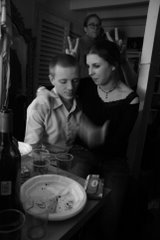
Gorgeous Chook and I are expecting a baby! or whatever the combination of our gene pools can muster. So far so good. I'm around three and a half months pregnant and apart from an extremely drunken family wedding and boozy holiday in the UK I've been pretty good (define good). Scans, blood tests and the rest indicate all's normal. So! the baby is due around mid January 2013.
That's the nice part. Now let's talk about uncontrollable farting, shall we?
mardi 10 juillet 2012


So here we are fighting in the Hunger Games
The Hunger Games by Suzanne Collins
In a nutshell: in a post apocalyptic world where 12 districts are ruled under the Capitol's iron fist, Katniss Everdeen, our pubescent rebel, is selected for the Hunger Games where you either kill or are killed, for the amusement of all those watching on live TV.
The blurb: the theme sounds familiar because it is, maybe inspired by the cross-fertilisation of Battle Royale and Lord of the Flies. It is the potentially not-too-distant future and the world has been re-organised. Each of the twelve districts must select 2 teenagers who will be sent like modern gladiators to the Arena, a vast territory where the outcome is either glory or death. One doesn't get a glimpse of the Arena till well into the book, the first half of it dealing with the complex life and personnality of our heroin who struggles to help her family survive and her subsequent grooming as one of the selected. In fact much more of the book is dedicated to the setting of the harsh new world, the description of the characters and their complex relationships than to actual fighting. The themes of totalitarianism, love, duty, friendship and betrayal are much more present here than blind violence. Though the book can be read alone, it is clearly the foundation of what turned out to be a trilogy.
IMHO this was a lot better than I thought it would be. Panem is an interesting and unusual world and Katniss and her acolytes have rich and developed personalities that twist the storyline in unexpected ways. Though there is nothing new with the concept of the actual Hunger Games ( Battle Royale), the way they are portrayed here touch on the themes of reality TV, modern sponsorship and political repression. A pretty damn good holiday read all in all.
In a nutshell: in a post apocalyptic world where 12 districts are ruled under the Capitol's iron fist, Katniss Everdeen, our pubescent rebel, is selected for the Hunger Games where you either kill or are killed, for the amusement of all those watching on live TV.
The blurb: the theme sounds familiar because it is, maybe inspired by the cross-fertilisation of Battle Royale and Lord of the Flies. It is the potentially not-too-distant future and the world has been re-organised. Each of the twelve districts must select 2 teenagers who will be sent like modern gladiators to the Arena, a vast territory where the outcome is either glory or death. One doesn't get a glimpse of the Arena till well into the book, the first half of it dealing with the complex life and personnality of our heroin who struggles to help her family survive and her subsequent grooming as one of the selected. In fact much more of the book is dedicated to the setting of the harsh new world, the description of the characters and their complex relationships than to actual fighting. The themes of totalitarianism, love, duty, friendship and betrayal are much more present here than blind violence. Though the book can be read alone, it is clearly the foundation of what turned out to be a trilogy.
IMHO this was a lot better than I thought it would be. Panem is an interesting and unusual world and Katniss and her acolytes have rich and developed personalities that twist the storyline in unexpected ways. Though there is nothing new with the concept of the actual Hunger Games ( Battle Royale), the way they are portrayed here touch on the themes of reality TV, modern sponsorship and political repression. A pretty damn good holiday read all in all.
dimanche 15 janvier 2012
So here we are electioneering with Joan of Arc
Happy new year! And welcome to the official opening of the French presidential campaign 2012. Indeed, since the first of January, all announced candidates have been under scrutiny, and will be until round one on April 22nd; all their TV and radio appearances are now timed to guarantee perfect media-time equality. This is straightforward enough when announced candidates such as François Hollande (Parti Socialiste, credited as being next president if one takes any notice of the polls), Hervé Morin (Nouveau Centre, 0 to 1% depending on the day), François Bayrou (Modem, centrist, 7%) and others speak into the mike: their time is counted and the idea is that everyone will have spoken the same by the eve of the first round.
It gets a little more tricky whern it comes to counting the speech time of the unofficial candidates, the biggest of these being the current president, Nicolas Sarkozy. Sarkozy has yet to announce his running for election (though there is a 98% chance he will stand) and, as the President has a certain number of speeches, conferences and visits in his diary, it is turning out to be a nightmare deciding when Nicolas "the Prez" Sarkozy is talking as opposed to Nicolas "the candidate" Sarkozy is. To be fair, this is nothing new under the sun. All former French Presidents have waited until the last possible moment before declaring their second candidacy. Valery Giscard d'Estaing in '81 waited until March (and lost), Mitterand in '88 waited until March (and won), and Chirac in 2002 waited about the same (and won). The notable difference between these guys and Sarko is the latter gives a conference every couple of days.
The CSA, the French audiovisual watchdog that cares about such matters, has decided to analyse every word of every presidential intervention; when he talks about the need to pull together in a crisis it'll be considered legitimate President-talk; when he slams into the opposition talking about their insane fiscal policies it'll be docked off his speaking time.
But of course it's a fine line as was recently illustrated by the Joan of Arc episode. Joan of Arc, French national heroin, martyr saint and semi mythological peasant maid who is meant, aged 14 to have kicked the English out of France under God's guidance, was born 600 years ago (we think).
An important figure in French national consciousness, she has been for decades the possession of the far-right Front national who seen in her the young, guided and original French resistant, who was burned at the stake for heresy no less. Staunch National front supporters actually gather around Joan's gold statue next to the Louvre every first of may to celebrate the dedication and sacrifice of the "pucelle d'Orléans." So when her rather approximate 600th birthday came round Sarkozy decided to celebrate the event in Vaucouleurs, from where she launched her military campaign that eventually led her to Orléans and the coronation of Charles VII, over half a millenium ago...
Sarkozy is communications genius, and his use of symbols was already omnipresent in his 2007 campaign. In 2007, he accumulated refernces to the right, with the great Charles de Gaulle, resistant who saved France from the nazis and went on to become the founder of the Vth Republic, or Jean Moulin and André Malraux, major figures of the Resistance. More interestingly, he also appropriated a lot of left-wing figures, as early as January 2007 he was raving on about Jaurès and a little later Guy Moquet, the communist youth who was shot for resiting the Nazis (see post here).
Now that it's 2012, he needs to innovate and find some new unifying figures. Napoleon would be an idea but of course for Sarkozy such a choice is impossible. Since day one he has been accused of strutting around with the same megalomaniac ambitions as his fellow shorty "hyperpresident", and is often nicknamed Sarko Ier in the satirical publications. Impossible equally for Louis XIV, who as well as centralising France around Paris and modernising the country a great deal was also an egomaniac who called himswelf the Sun King.
So Sarkozy has gone into French mythology and craftily nicked, with excellent timing, the Jeanne d'Arc figure from the extreme right. A misunderstood character who ultimately led France out of the Dark Ages and the Hundred years War to independence, peace and prosperity. Remind you of anyone? And of course because this was a national hommage to a French heroin, it was the president who was doing all the work, not the candidate so the CSA can't charge him for this. What other mythological character associations can we get from Sarkozy before he declares his candidacy?
Sarkozy is communications genius, and his use of symbols was already omnipresent in his 2007 campaign. In 2007, he accumulated refernces to the right, with the great Charles de Gaulle, resistant who saved France from the nazis and went on to become the founder of the Vth Republic, or Jean Moulin and André Malraux, major figures of the Resistance. More interestingly, he also appropriated a lot of left-wing figures, as early as January 2007 he was raving on about Jaurès and a little later Guy Moquet, the communist youth who was shot for resiting the Nazis (see post here).
Now that it's 2012, he needs to innovate and find some new unifying figures. Napoleon would be an idea but of course for Sarkozy such a choice is impossible. Since day one he has been accused of strutting around with the same megalomaniac ambitions as his fellow shorty "hyperpresident", and is often nicknamed Sarko Ier in the satirical publications. Impossible equally for Louis XIV, who as well as centralising France around Paris and modernising the country a great deal was also an egomaniac who called himswelf the Sun King.
So Sarkozy has gone into French mythology and craftily nicked, with excellent timing, the Jeanne d'Arc figure from the extreme right. A misunderstood character who ultimately led France out of the Dark Ages and the Hundred years War to independence, peace and prosperity. Remind you of anyone? And of course because this was a national hommage to a French heroin, it was the president who was doing all the work, not the candidate so the CSA can't charge him for this. What other mythological character associations can we get from Sarkozy before he declares his candidacy?
lundi 26 décembre 2011
So here we are falling with giants
Fall of Giants by Ken Follett
In a nutshell: as always with Ken Follett in a nutshell is complicated as this volume, the first in a triolgy spanning the main events of the 20th century, is 850 pages long. Here goes. We start in 1911 in a small Welsh mining town. We meet several characters, Billy, teenage miner and his beautiful sister Ethel who works at the local rich man's house. We meet Fitz, the local rich man, and his Russian homesick wife. All these people and many moreare the center of a huge web of lives that span from the outbreak of the first world war, the Russian revolution and America's intervention in the war.
The blurb: Ken Follett is reproducing exactly the same tricks as with his previous books, Pillars of the Earth (read review here) and World without End (read review here). The idea is that we follow a cast of dozens, who are all more or less related, sometimes in the most improbable ways. The backdrop is a page turning 8-year chronology of the bloody trenches in northern France to the fragile start of the Soviet Union. We follow characters in the States and get a flavour of immigrant New York as America's politicians prepare for war. Miners, soldiers, diplomats, spies, princesses, revolutionnaries, suffragettes, politicians, criminals, everyone is represented and weaves together the history of that time.
Sometimes though the links between the people are bizarre: the sister of the young miner we meet in Wales at the beginning is the mother of the bastard child of Fitz whose wife is a Russian princess who murdered the mother of Grigori who becomes Lenin's close colleague and Lev who goes to New York but lands in Wales in the very same mining town where Maud the sister of the Earl is having an affair with the German spy who... and so on. It actually gets a bit confusing, and there is a lot of blood, battle and fighting in the second part of the book whereas the first was more focused on the characters.
IMHO this started to get a bit long and boring about three quarters in. There are a lot of people and plots and thought it is interesting to see the bigger picture develop, we start to lose track of reality as we swap from Russian revolution to New York underworld to suffragette London and and Westminster war councils. Good for people who like big complex war sagas written in a one big breath.
IMHO this started to get a bit long and boring about three quarters in. There are a lot of people and plots and thought it is interesting to see the bigger picture develop, we start to lose track of reality as we swap from Russian revolution to New York underworld to suffragette London and and Westminster war councils. Good for people who like big complex war sagas written in a one big breath.
So here we are turning thirty
Or, as I like to put it, 28 for the third time.
On Saturday December 17th, three days after the big 3-0, Anthony told me we were going out for dinner. It turns out that he is taking me to a bar we go to from time to time, and that olivia, my super mate, has organised a surprise party for me with my school friends, uni friends (from france, Brighton was understandably not represented), parents and generally nearest and dearest. I was given some lovely presents, thought the one that touched me most was a huge album my parents and Olivia compiled with pictures from 0-30 and all the people I love here and abroad. Wept like a baby and poor Marie, who had already trawled around Galeries Lafayette before Xmas with Chook to find my perfect pressies, had to mop up the rivers of mascara in the tiny loo. Thank you all so much forthat incredible surprise!
Merci à toi ma Miss pour cette surprise exceptionnelle et inoubliable, cette preuve d'amitié dont toi seule a le secret, pour tes efforts et ta réussite, et pour cette amitié sans laquelle je ne serais pas comblée comme je pense l'être. Love you OFDMV.
So here we are looking at the big picture
The Big Picture by Douglas Kennedy
In a nutshell: following an unfortunate series of events, Ben Bradford- Wall St lawyer and family man- has to fake his death and become another, leaving everything including his family and identity behind.
The blurb: written as a first person account by Ben Bradford, the first third of the book starts with an overview of his life as a successful lawyer complete with big salary, nice house, 2 kids, a wife who collects furniture and an interest in photography. A dramatic event however means that Ben has to quickly give up his comfortable yet dull life, and disappear without anyone knowing. He takes on a new identity and settles in a new environment in a small town in Montana, and the rest of this book deals with the theme of identity, i.e. are we who we say we are? who we'd like to be? are we a sum of our actions? and so on. Ultimately the real page-turning element here is the tension that builds up as one realises that taking on a new identity involves a lot more than a name change, especially when it's such a small world and no man is an island.
IMHO this is a fun, easy and pretty compulsive read. Though it is quite funny, the real grip is the fear that at some point our hero will be found out. Part road story, part surrealist coming-of-age story, part comedy, it has a similiar tone as The Dead Heart by the same author (read review here). Recommended a a nice book to curl up with in the evening.
In a nutshell: following an unfortunate series of events, Ben Bradford- Wall St lawyer and family man- has to fake his death and become another, leaving everything including his family and identity behind.
The blurb: written as a first person account by Ben Bradford, the first third of the book starts with an overview of his life as a successful lawyer complete with big salary, nice house, 2 kids, a wife who collects furniture and an interest in photography. A dramatic event however means that Ben has to quickly give up his comfortable yet dull life, and disappear without anyone knowing. He takes on a new identity and settles in a new environment in a small town in Montana, and the rest of this book deals with the theme of identity, i.e. are we who we say we are? who we'd like to be? are we a sum of our actions? and so on. Ultimately the real page-turning element here is the tension that builds up as one realises that taking on a new identity involves a lot more than a name change, especially when it's such a small world and no man is an island.
IMHO this is a fun, easy and pretty compulsive read. Though it is quite funny, the real grip is the fear that at some point our hero will be found out. Part road story, part surrealist coming-of-age story, part comedy, it has a similiar tone as The Dead Heart by the same author (read review here). Recommended a a nice book to curl up with in the evening.
jeudi 1 décembre 2011
So here we are thinking about a new EU treaty
Well! Sarkozy is on TV, live from a crammed concert hall in Toulon, giving some hot presidential speech. Blah blah blah, he was saying, right at the end (3 minutes before credits) that he had had to deal with a very horrible financial and economic catastrophe at Eurozone level with Merkel, using the framework of a rusty 1992 Maastricht treaty which turned the EEC in to the EU and invented the economic and monetary union.
Fair point. As he mentioned, the treaty provided clauses for preventive measures against financial meltdown, but no body to make sure they were properly applied. Penalties were devised in case of ridiculous deficits and debt levels, but nobody put them in place or used them. There were no institutions that could take over when things flew out of control. Which is why France and Germany have had to pile the steaming ruins of EU economies into a shit heap and sellotape it together.
Sarkozy explained the eurozone countries economies must converge or the euro will be either too weak for some and too strong for others. To do this, wait for it, it was necessary to draw up a new treaty which implements... economic governance at an EU level. France and Germany would strive for this.
BUT WHAT DOES IT MEAN?
Well, what it probably doesn't mean is that the new institution/level of power would be independent like the ECB, which stays firmly out of politics and lives to keep inflation down, cos that's part of the whole fucking problem, that monetary policy (printing the money) cannot be used in crisis situations, and that is why all the governments are focusing on fiscal policy (more money in taxes, less spending). But the Germans would never agree to that. Independent monetary policy is their condition. So what? A new branch of the commission that decides on centralised economic plans for each sovereign country? sounds unlikely. So maybe they're just going to start applying what's been written all along since the bloody Maastricht treaty, followed by Nice, Lisbon and so on.
So is this the scoop? It takes European rules 19 years to apply? or are we going a step further ijn EU integration with an incredible new political system, where a supranational economic governance (nment?) which is independent from the supranational central bank, has to face the specificities of each (sovereign?) eurozone member?
Can't wait to find out!
Fair point. As he mentioned, the treaty provided clauses for preventive measures against financial meltdown, but no body to make sure they were properly applied. Penalties were devised in case of ridiculous deficits and debt levels, but nobody put them in place or used them. There were no institutions that could take over when things flew out of control. Which is why France and Germany have had to pile the steaming ruins of EU economies into a shit heap and sellotape it together.
Sarkozy explained the eurozone countries economies must converge or the euro will be either too weak for some and too strong for others. To do this, wait for it, it was necessary to draw up a new treaty which implements... economic governance at an EU level. France and Germany would strive for this.
BUT WHAT DOES IT MEAN?
Well, what it probably doesn't mean is that the new institution/level of power would be independent like the ECB, which stays firmly out of politics and lives to keep inflation down, cos that's part of the whole fucking problem, that monetary policy (printing the money) cannot be used in crisis situations, and that is why all the governments are focusing on fiscal policy (more money in taxes, less spending). But the Germans would never agree to that. Independent monetary policy is their condition. So what? A new branch of the commission that decides on centralised economic plans for each sovereign country? sounds unlikely. So maybe they're just going to start applying what's been written all along since the bloody Maastricht treaty, followed by Nice, Lisbon and so on.
So is this the scoop? It takes European rules 19 years to apply? or are we going a step further ijn EU integration with an incredible new political system, where a supranational economic governance (nment?) which is independent from the supranational central bank, has to face the specificities of each (sovereign?) eurozone member?
Can't wait to find out!
Inscription à :
Articles (Atom)