mardi 2 septembre 2008

So here we are summering in the south I

Aaaah, 'tis the rentrée today : the kids are marching to school under a cold grey sky, autumn fruits are appearing at the greengrocer's and the supermarket cashiers are back, sullen, except when they talk about the fruits de mer they ate last week at La Rochelle; gloom and the prospects of another 11 months until August are in the air.

So to start this blog rentrée it may be useful to go back on the summer holidays a little : post CELTA I zoomed down south, first with my parents to stay with an old friend of my dad's who lives in the small village of M., located between Avignon and the Mont Ventoux. (That's in the south east of France, you geography philistines). From then I went a bit further south and a bit further east to beautiful Ampus (see last year's post) with my buddies.

********

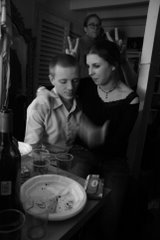
So, first to M. : here is what I wrote at the time, laziness prevents me from doing more. This is piccie of mum & dad, and our lovely hosts, Bob and Sookiang.


From the outside it looks like a tall skinny town house squatting between the intersection of two quiet roads that cross the village, inside it is like stepping into a post renaissance mansion.


You come in through the garage which is on street level and enter a massive wooden front door, the kind you find in churches and adorned with huge iron studs. You enter a windowless hall made of light stone. A magnificent wooden staircase winds upwards, to the left is a room full of storage and crap, to the right is a room leading to the garden. There, to the right is a terrace with tall hollyhocks and other flowery shrubs invading it, down a couple of steps is the covered terrace with the huge table and, get this, an open kitchen with air conditioning! Vines, ivy and flowers grow all around it, you forget you are in a village.

Down a couple more steps is another terrace, for sunbathing and the inescapable pool, which is just a bit too small to be useful and too chlorinated to be agreable. Still good after two hours baking in the sun though. Going round the pool is a door leading to the wine cellar (built like a Fort Knox bunker, full of incredible bottles), and above it is a roof terrace perfect for getting skin cancer.

Beyond the pool is a wrought iron gate that leads to the ornamental garden, designed like Versailles with an olive tree filling the symmetrical paths and a gorgeous potager/verger at the end. All in all? probably about 400 sq meters.


So back to the house. You walk up the staircase, all polished wooden bannisters and beautiful square tommettes (200+ years old). On the first floor there is a large pallier filled with dark old polished furniture, 18th century cabinets all carved with twisting collonades, embroidered chairs, large dark paintings of bowls of fruit. Looks like some of the rooms in a lesser known chateau.

On this floor is the massive kitchen and dining room (more wooden furniture, ultra modern kitchen, bookshelves full of first editions) and a huge sitting room, a mix of pastel ultra modern leather couches and plasma TV screen, more dark antiques, huge bookshelves and a wall of books, all with view on the layers of countryside with a backdrop of Mont Ventoux. On the other side of the pallier, overlooking the village are the « official » sitting and dining rooms, full of valuable furniture and.... Bob's pewter collection. Shelf after shelf, imposing tables and desks covered in pewter candlesticks and dishes, jugs and statuettes. Like a museum.

Another flight of stairs to the floor with bedrooms, four again, huge, antique tommettes inlaid with wooden beams on the floor, en suite incredibly modern bathrooms, more medieval, renaissance furniture and paintings and sculptures. The last floor is where the master bedroom is, two offices (each comfortably larger than our flat) and... a room for their clothes. The view from this height (fourth floor) is just stunning.


So the setting is nothing short of incredible. When they are all having their afternoon naps I sneak around and look at the stone walls and floors and the 500 year old collections, the gleaming oak furniture and the paintings. It's like being in a haunted château only here there are no guards and you can touch the paintings and read the books.


Other than mum, dad, Bob and Sookiang there are other guests: Bob's daughter Kate and husband Andy, with three month old Oona, the fattest and most cheerful baby ever. Kate spends most her time fretting and breastfeeding, but is very nice, as is Andy. His brother Dave, a nice, quiet guy who works in IT (my parents are hassling him to get wifi to work...) and has good taste in books is also here, as is Kate's brother James, who is really good fun. We've discovered a bit in common as Dad and Bob seem to be similar fathers.


Food of course is amazing: we went to an awesome restaurant the other night and have generally been eating very well : coq au vin and gaspacho, terrines and fresh fish and incredible cheeses, tonight paella and yesterday I made my mint and mango tabbouleh which went down pretty well. Wines I won't even start on; we are drinking rarissime bottles of chateuneuf du pape and other incredibles. Unfortunately I know nothing about them, much to dad's dismay.

Went to village fête with James and Dave (Andy and mum joined
us for the dodgems) after super boozy supper in a nearby village (red mullet with hazelnuts and avocado ice cream, overcooked bull and a nasty lime tiramisu). We danced to the local [lack of] talent, went on the dodgems, shot balloons for ugly teddies, had a couple of pastis, good fun!

dimanche 3 août 2008

So here we are looking back on CELTA


God, it was a bitch of a tough month. 5 assignments, 6 hours teaching (plus endless nights of preparation), 9 hour days, endless new jargon to assimilate and reproduce in a semi intelligent way (e.g. "you do not have freer language practice in a skills related lesson, only when doing language focus; for the former one needs to think in terms of fluency practice"... this was an actual comment on one of my lesson plans). So yeah it was tough, exhausting and quite rigidly fascist, in that the CELTA method is the CELTA method and anything else you knew or thought you knew you lust forget about. Still it was interesting, as were the people and, behind the blurb, some of the techniques we have been taught. that said, I think some of us are going to be using concept questions spontaneously for a few weeks, and drilling is now a part of everyday life.
( Apologies to all friends who are going to have put up with me).


Here are some of the main points I learnt on this course (english language technique-wise I mean, not that falafel and cognac don't mix) plagiarised from my shamelessly ball-sucking "lessons from the classroom" assignement.

Useful techniques and procedures observed in the classroom

a) Techniques for motivating learners

An important thing I have learnt from observing my peers is the importance of putting the learners in a context/situation which they feel involved in. Playing a piece of music, greeting the students, bringing in realia or other props that allow the students to be introduced to the context clearly awakens their interest and makes them more curious about the topic.
This is in fact essential for eliciting information from them. During one observation lesson, the teacher shrewdly brought up the subject of “Money”, which prompted a lively discussion amongst students and led them smoothly into the actual lesson. They were able to provide a lot of vocabulary and the initial interest in the topic meant that they could then enthusiastically consolidate this vocabulary in a freer practice context. As a result the teacher’s talking time (TTT) was kept to a minimum, which would clearly not have been the case if the students had not been keen and motivated initially.

b) Procedures for error correction

Early on in the course we were taught about error correction; before that I had mainly been interrupting students and correcting them myself when they were wrong. When I saw a teacher doing error correction by eliciting the right answers from the learners it became clear that this was a far less ostracising and critical way of doing things. It also increases student talking time. Equally using gestures/finger techniques (several of my peers are very good at this), mimes, prompting with the first letter of a word or by giving the nature of the mistake are all techniques I have observed and tried to adopt.
Also, keeping some corrections “anonymous” (by grouping all mistakes at the end and reviewing them during general feedback) when in a skills lesson is a technique observed in the second week. It clearly makes the students more comfortable. During another session, a teacher used the mistakes to extrapolate and review certain grammar points, pronunciation issues and meanings. This taught me that every mistake can be useful, in that it provides an opportunity to consolidate previous points.
Finally, on this point I have observed many times that when the students are reading/ writing/ speaking in pairs/ working it is important not to intrude and make them feel as if they are being spied upon. One teacher in particular was described by one student as “moving subtly amongst the groups” which I think is a good way to describe supervising without being too obvious.

c) Knowing how many points to cover

Two different lessons (that my colleagues were teaching) highlighted some “Dos and Don’ts” when it comes to teaching grammar. First of all, grammar seems more confusing and far less natural to students than a skill based lesson (this is something I have observed every time: TTT time is far greater in grammar lessons). In one case the students spent an entire session on a relatively simple grammar point. The other tried to teach three or four in the same time. The lesson was that it is far better to go away having taught one small point well than three. It is therefore important not to underestimate the importance of teaching grammar slowly, with plenty of practise.

d) Techniques for being understood and listened to.

Early on in the course I had trouble grading my language and drilling the students. I found in both cases that it was slightly insulting to the students to do this. When we got a language lesson in a completely unknown language however it became clear that there is nothing insulting about speaking in a clear, calm, understandable way, and even less wrong with repeating something that is unknown (like rehearsing a piece of music). I have observed that those who grade and who speak calmly are usually more listened to than those who are “chatty.” That said, being “snappy” is important to keep the students stimulated. I think the lady from the DVD achieves a good balance between being alert and energetic but still grading and being clear and concise.

e) Technique for eliciting – inductive presentation

Though there are many ways of eliciting from students (such as those mentioned in (b) ) one I think is particularly helpful when it comes to helping students understand the link between meaning and form is ‘inductive presentation’. I have seen three classes where this was used, and I find it a very useful and practical way of eliciting (here) grammar points. It is also quite gripping compared to a lot of grammar classes as there is almost a playful quality to it. I tried this technique for my ‘focus on the learner’ teaching and the student thought it was great fun. (It was also very effective.)

No, he didn't actually, but hey, a bit of poetic licence...

Anyway, also from the July 2008 CELTA course I will keep good memories of my colleagues. First a moment's silence for Keith who gave up on day 3 after brutal criticism and failing his lesson.

*Moment's silence*

And a great roar of "Yay!!" and "all the best!!!" to Erin, Ronnie, Christen, Jenny, Ben, Sonia, Dan, Clare, Tracy and Lucette. Nice to meet y'all :)


Pictures courtesy of Ronnie and Erin

jeudi 31 juillet 2008

So here we are reading Douglas Kennedy

OK! OK! OK! I admit it, I am re-re-re-re-re-re-re-re-reading the Harry Potters, again. After only 3 months. It hasn't stopped me reading this though.

The Woman in the Fifth by Douglas Kennedy

In a nutshell : a lone american called Harry settles in Paris and works in a crap job in a shitty area as he tries to write his novel. He meets strange woman Margit at a party and starts an affair with her as his life becomes increasingly peculiar.

The blurb : Weird book. Starts an as ambling, slightly slow paced read of an American who flees his home in the US after a scandal and tries to write a novel. Nice descriptions of the grubbier side of Paris and its underground networks, and his crap situation is credible. Quite early on he meets this mysterious woman then... well, weird stuff happens. Bit of a fantastic denouement (but still quite enjoyable) but nothing really goes anywhere and the end is a bit of an anti climax.

IMHO this OK. it's my first DK book and I'd probably buy another of his. Bit strange though, neither thriller (too slow, no action), nor romance, neither particularly dramatic, and certainly not a funny. There is a twist and I'll say no more. Good for a long winter evening.

dimanche 13 juillet 2008

So here we are teacher training with CELTA

Phbtttt, what a week! Last Monday I started the CELTA course which, in a month of gruelling intensive training, will (hopefully) allow me to become a teacher of English here in Paris. And it's been one hell of a week. It all started at 9 AM in a grotty lino-floored and plastic seated room in a building in the Passage Dauphine, in the latin quarter. Twelve of us sat around while an enthusiastic Irish teacher outlined the course and a bit of the CELTA philosophy : plunge 'em in and let 'em work it out as it goes along. This means that we study teaching on a monday and teach every afternoon from Tuesday onwards, while following "theory" classes in the morning. These are scheduled as "Error correction", "Lesson planning" or "Pronunciation and drilling", and despite being full of teacher jargon and half baked modelisations of what teaching is, do address some interesting points that one must bear in mind while teaching.

So late on Monday afternoon, after a day of getting used to the course and getting to know the others, we start to pan our very first lesson. Having been divided into two groups of six we got acquainted with lesson planning. Panic. Each of us has a twenty minute slot in which we must address a particular aspect of language teaching.

[You really want to know? ok then : language practice (2 slots) is about in-putting vocabulary and then using it, in interrogative sentences for ex; skills teaching (3 slots) consists in listening, reading and writing exercises, while the last slot is devoted to the "freer practice" during which the students (or learners as they are called) apply what they have learned in a less structured and supposedly more "fun" way. it's actually a good way of doing it.]

So long days (9h15 to 6 if you're lucky) and even longer nights as one frantically tries to prepare a teaching practice that will allow one not to make a complete dick of oneself in front of a class of fifteen adults. This first week has required a certain amount of imagination, be it to prepare a text that may inspire them to answer questions on, to deciding how best to review the alphabet, or how to get them to practice vocabulary relating to description.

But despite the massive work load (I'm tired...) i's been good fun. The course buddies are all nice without exception, though I spend a lot more time with the other five in my teaching group. We are an international lot : Ronnie from Austria, Erin and Christen from the US, Jen from the UK and French Sonia. And we teach! Not always amazingly but sufficiently well to have held the class's attention every day and hopefully taught them a few things about English.

There have been slightly awkward moments of course : for example after 10 minutes of teaching I realise that I have got to the end of my lesson plan (so lets improvise a writing exercise, to everyone's dismay). The main was however when I decided to teach them "lighthouse". there is a strict "No other language than English" policy, so I thought the best way to make them understand would be to draw one on the board. As I did so, adding a long tall lighthouse to the pile of rocks I had added for extra atmosphere, I heard sniggers which of course were directed at the enormous erect penis I was casually sketching. Oops! I had a light at the top: the penis hole. I add a beam of light shining from it: wow! ejaculation. Can it get any worse? Yup. I desperately add stripes to the lighthouse (in my mind's eye lighthouses have red stripes on them), it somehow makes it look even more so. I add a boat to draw their attention away : a vaginal sloop. Lots of giggles (good god, their ages range from about 25 to 50!). Still, if that is the worse thing I do I'll be happy.

On another note however. The CELTA, prestigious and no doubt efficient as it is, seems a bit of a rip off. For €1525 (yes, a thousand quid) we get lousy facilities (albeit in a stunning location in the latin quarter) where the tape machine is antique, the books museum-quality, the plastic seats have broken flaps of 'table' badly screwed to them. There are no stapler, scissors, hole puncher or even decent pens for the board. And to top it all we teach people (in our case unemployed) who also pay! It can't all go on the rent and the salaries of the tutors!

So here we are salmon fishing in the Yemen

Salmon fishing in the Yemen by Paul Torday

In a nutshell: Public servant Fred Jones is a fisheries scientist and is landed with the impossible task of introducing salmon fishing to the Yemen, on the orders of a richissimo sheikh and under pressure from the British government, who think there is a good photo op behind the whole plan.

The blurb : This novel is written as a series of emails, diary entries and letters between varipous protagonists. You follow the unfolding of an impossible plan to introduce salmon fishing to the Yemen as a local political figure believes that it would be good for the hearts and souls of the Yemenite peasants. Gradually Fred Jones becomes wrapped up in this insane plan : first unwillingly but obliged to because of the political pressure that is put on him by Downing street, then with enthusiasm as he falls under charm of the (deeply religious) shiekh's faith in the project and the young lady he collaborates with. Meanwhile his marriage is failing and the politics become increasingly hard to deal with.

IMHO this is a fabulous, funny, touching, remarkable and highly original novel. Adjectives lack! The main plot line unfolds mainly through the diary entries of Fred, the fisheries scientist, and many sub plots (failing marriage, Al Qaeda dodgy dealings between the Yemen and GB, semi love affair with his collegue, absurdity of political spin) are subtly exposed via letters and emails. This book is not just an opportunity to laugh at the absurdity of such a plan; it also touches on subjects of faith, spin and love. And for those who fear that such a story can only end in laughter or tears, be prepared to be amazed. Very highly recommended, any place, any time.

samedi 5 juillet 2008

So here we are furious about the Narnia movie

Why, oh why, oh why?

So let's take a book, not any book, but a hugely popular classic from children's literature and turn it in to a movie. OK, nothing new here. But rather than preserve the book which, let's face it, has been proving for over fifty years that it is massively enjoyable, let's change the pace, the cast, the storyline and the general esprit.

And guess what? The result is absolutely fucking lamentable. The Chronicles of Narnia part 2 : Prince Caspian is an absolute flop.

Let's start with what is probably its major flaw : it's sooo long. Nearly 2 and a half hours... Nothing wrong with that at such (The Godfather, Schindler's list) but an absolute killer when the pacing is all wrong, which here it is, as the writers decided to change the order of things.

A reminder that all you real Narnia fans will not need : PC starts with the four Pevensie kids who are whisked off to Narnia, where they rescue the dwarf Trumpkin. He launches in to a long flashback of narnian history and the latest developments, mainly the life and times of PC. From then the kids and he go off in search of him (many trials along the road). When they finally meet it is the start of the battle which will, after twists and turns, save Narnia.

Let's recap the pace and order of the book :

1. Pevensies arrive in Narnia and meet dwarf (3 chapters).
2. Long flashback (the dwarf's tale) about Modern Narnia and Caspian (4 chapters)
3. Journey to Caspian, along which they are reunited with Aslan (4 chapters)
4. Preparation and Battle (4 chapters)

The movie does nothing of the sort, preferring to skip back and forth between Pevensies and Caspian for the first part, and then embarking on the battle sequences once all are reunited, i.e after about 35 minutes.

Many problems with this, the main flaw being that the dwarf Trumpkin has known Caspian for all of twenty seconds (it is not clear whether he even knows who Caspian is) yet still knows where to take the children and why he knows he must bring them to him. Illogical at best.

As a result the pace of the book/movie is ruined. The history of Narnia is swept over, Caspian's army forms effortlessly it seems, the journey to Caspian is turned into a relatively pleasant walk in the woods, the children meet the prince far too quickly. As a result all the groundwork disappears and too much (most) of the film is devoted to battles, including one, taking place in Miraz's castle, that is purely invented by the film people.

Doctor Cornelius is reduced to a minor character, the talking beasts are no longer personalised (other than the mice led by Reepicheep), no more giant, no more bears. Glozelle and Sopespian are given too much importance, Aslan practically disappears from the storyline. As always when personnalities are replaced by special effect-boosted battles, all subtlety and background are lost. Caspian is reduced to a juvenile, sulky idiot you want to kick in the teeth.

Here are many other things that were completely wrong : Caspian and Peter are like two creepy adolescent rivals, the journey to Aslan's How virtually disappears, the semi love story between Susan and Caspian is totally weird, the battle at Miraz's castle is absurd (the High King leaves his men to die??), the lack of Aslan turns the story into a tearful attempt to understand "Why? Why doesn't he come?" (bringing on issue of faith, which is much more subtle and less central in the book). For some reason a pointless scene resurrecting the White Witch was added, to show a weak and treacherous Caspian (damn! this guy was my childhood fantasy man, what have you done to him?)

That said, some bits, carefully selected, were ok. I think the Pevensie children are fine (though Peter overdoes the testosterone and Lucy seems slightly retarded), the badger Trufflehunter is sweet, the dwarves are good, Reepicheep is fine though a bit Disney-ish. The duel between Peter and Miraz is good. The final battle is ok. Special effects, especailly Old man River, were cool. Locations and scenery were good.

Er, that's it. The costumes were disappointing, the characters two dimensional, the storyline nonsensical and the pace totally buggered.

So there, a big nono. Narnia fans will get the best bits from the trailer, and non fans should, if interested, read the book, definitely not watch the movie.

For the next one, the Voyage of the Dawn treader, I have only one piece of advice : stick to the goddamn book.

mercredi 2 juillet 2008

So here we are reviewing more books

Haven't been reading as much as I would like, but here are the latest tomes to have transited via the bedroom table.

The World according to Bertie by Alexander McCall Smith

In a nutshell : 8 year old Bertie and a cast of a dozen or so inhabitants of Edinburgh's 44 Scotland street go around their daily lives of whinging about the neighbours, falling in and out of love, having a new baby brother (half brother actually, the father is your shrink), being an artist etc.

The blurb : We follow a sprawling set of people's lives, all interconnected in some way or another. A lot of the storylne is slightly absurd - a dog on death row, control freak adulterous mothers seen through an 8 year old's eyes, rocky relationships in particular circumstances. We switch from one set of characters to another (i admit, i occasionally got confused) and get to know them through all the little details that AMS captures brilliantly.

IMHO this is not as funny as the Number 1 Ladies detective agency series, also by AMS. It is quite fun to read but it doesn't really go anywhere, which I suppose is the point as none of the characters lives are at any stage building up to a kind of climactic dénouement. It tootles along, hopping from one person to the other, then just ends. Ok, but I'd check out his other books first.

Notes from an exhibition by Patrick Gale

In a nutshell : Artist Rachel Kelly was manic depressive and has committed suicide. Through a series of her exhibition notes and flashbacks of her life and that of her family we learn about her creativity, her illness and her family history.

The blurb : this is an airy book, full of Cornish light and Quaker Meeting houses, but filled with leaden stories of a bipolar artist genius and her dysfunctional family. The story of the family is pieced together from bits of everyone's lives : the father, the mother, and the four children. Main themes are tolerance, creativity, conformism, rebellion, depression and death, presented at various paces.

IMHO I can't work out whether I liked this or not. On the one hand it is beautifully written, very evocative with a powerfully bleak storyline. On the other it is a little slow, as one plunges into the thoughts of each of the protagonists and can read like a group psychotherapy session. Strangely though it ends a little abruptly imho. Good winter reading, when the world is a little dark and slow. Not one for the beach.

What Einstein told his cook by Robert L. Wolke

In a nutshell: Why is meat red and what is the catch with low-sodium salt? How do microwaves work and does a bit of potato really absorb excess salt in soup? And how about the diference between raw sugar, treacle, molasses and golden syrup? Or baking soda and baking powder? and what the hell is umami?

The blurb : all these questions and many many more are answered in this brilliant book written by a chemist. It is all divided by theme (sugar, salt, fat, "fire and ice", etc). We all know cookery is chemical, but here we discover what exactly is going on and what the things we eat are. Clear, very funny (as in laugh out loud), comprehensive and with just the right amount of science, it brings answers to many questions you'd never asked, or even thought about.

IMHO this is the best book I've read since... ages, and certainly the best non fiction food related book. Other than its qualities described above, it is also a must read for anyone who is serious about cooking and good fun in general. Full of incredibly interesting facts, and a good way of learning a bit of chemistry too. Very highly recommended.