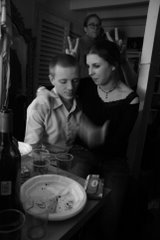
I was sitting by the canal the other day having an early evening drink with some friends when I mentioned that I was now officially unemployed until September 14th, date at which my new contract starts at the language school. I was about to launch in to how I would spend this free time (namely start my new business) when all three quipped, almost in unison, "So, have you got your unemployment benefits yet?". "No", I answered, "I've got a job lined up, I live practically rent-free, have an allowance, was paid generously when my contract finished and have got plenty of money in my (three) accounts, I don't think I need it." Stunned silence. "But, but, you've cotised" they explained, as if to a jungle-resident who has just landed in the welfare state.
These three friends have a point. As a French employee, a generous hunk of my salary goes to the State: 327 euros a month to be precise, i.e. around 25% to 30% of my gross salary. In fact 33 euros a month have gone to the unemployment benefits vault and, true, I could claim around 500 euros a month until September (though I have only cotised around 270 euros). The way they see it is this: you've contributed to the kitty, you are entitled to the kitty. End of debate. Is it though?
These friends consider themselves fiendish left-wingers. One of them has already voted communist at a Presidential election. They think the right-wingers (dangerously close to the evil droite néo-libérale anglo-saxonne) are selfish, individualistic exploiters who like nothing better than sending the prolétariat down the mines so that they can afford a fourth annual holiday in the Maldives (a little exaggerated, but that is the gist.) Yet here they are saying that I should milk the State for a bit because, clearly, if I am entitled to it, then it is my due.
I also consider myself a rabid left-winger, but this has left me pensive. Thinking about it, it occured to me that here we have two very different views of taxes and the State. I adhere to the concept of redistribution, you take money from those who can afford a bit to spare and expect everyone to have a slice of it when required. This is true especially when it comes to health and education, but also unemployment benefits, especially when there are 800 000 extra unemployed - mainly unqualified industrial jobs, with mortgages to pay and children to feed - because of the financial crisis.
But there are very finite and limited ressources to share out, so what will there be left for those who need benefits if those who don't use up the money? The French debt and deficit are enormous, increasing and unsustainable. The Social security balance is so deep in the red that there is a serious debate about when the system will crash.
For me, not taking benefits is solidarity; I don't mind paying for those who need beneits and, the other side of the coin, do not expect people who don't need them to profit from them. My friends take a different view: the law says you can, so you should. But this seems to me very close to the pay-as-you-go individualist concept of welfare that is estasblished in the USA: put your money in then take your money out, regardless of whether others need it more, which they rightly criticise and consider non-humanitarian. This is the worst kind of non-individualism: when you see things through the prism of the State and no longer act out your views because you don't consider your individual self to be an actor in the scheme of things.
My moral to this anecdote is this: your views should not change according to whether there is a law in place or not. If you believe in redistribution and sharing out of wealth, you should be prepared to accept that some of the wealth you have is given out. The law is there to give you a right, not an obligation, to have support, and it is up to your political consience to determine who deserves it most- those entitled to it or those who need it. And then act accordingly. Amen.
Affichage des articles dont le libellé est work. Afficher tous les articles
Affichage des articles dont le libellé est work. Afficher tous les articles
vendredi 17 juillet 2009


dimanche 12 octobre 2008
So here we are laughing at the students
As I quite like working as an English language teacher at EL, a language school in Paris, I shall not give the usual scathing review of my current job's stupidity. For that I will have to wait until December, when my contract runs out. Still, it does not say anywhere that I cannot mock my students. In a nutshell, my employer is a language school that specialises in one week intensive courses aimed at corporate employees. The greatness of the method is debatable, but the students seem to like it and actually learn something.
That said, I hear a lot of bloopers : mispronunciations, misunderstandings, false friends (when a word exists in two languages but means something quite different) and so on.
Here are three I have heard so far.
Me - So, Jean Pierre, present perfect, do you have any pets?
JP- Yes, I had a rabbit.
Me- Tense! Jean Pierre, is your rabbit dead?
JP - Yes, I ate it.
Me- Ok! Véronique. Exercise : present simple. Tell me how you make crudités.
V: You take salad.
Me- Article! Véronique. In front of salad.
V- Ah. You take the salad. You boil the eggs. You cut the tomato. You rape the carrot.
Me- Véronique! No, that's false friend. We say grate the carrot.
V- Grate? You scratch the carrot?
Me- No! Véronique. That's french. Rape is grate.
V- Ah. OK. So you rape the carrot.
Teacher - What plant does wine come from?
JP- La vigne.
T- In English. Vine.
JP- Vine (vin is french for wine)
T- And the fruit?
V- The raisin (raisin is french for grape)
T- No. It's grape (grape is french for bunch)
T- And what do we call a collection of grapes?
V- Muesli.
That said, I hear a lot of bloopers : mispronunciations, misunderstandings, false friends (when a word exists in two languages but means something quite different) and so on.
Here are three I have heard so far.
Me - So, Jean Pierre, present perfect, do you have any pets?
JP- Yes, I had a rabbit.
Me- Tense! Jean Pierre, is your rabbit dead?
JP - Yes, I ate it.
Me- Ok! Véronique. Exercise : present simple. Tell me how you make crudités.
V: You take salad.
Me- Article! Véronique. In front of salad.
V- Ah. You take the salad. You boil the eggs. You cut the tomato. You rape the carrot.
Me- Véronique! No, that's false friend. We say grate the carrot.
V- Grate? You scratch the carrot?
Me- No! Véronique. That's french. Rape is grate.
V- Ah. OK. So you rape the carrot.
Teacher - What plant does wine come from?
JP- La vigne.
T- In English. Vine.
JP- Vine (vin is french for wine)
T- And the fruit?
V- The raisin (raisin is french for grape)
T- No. It's grape (grape is french for bunch)
T- And what do we call a collection of grapes?
V- Muesli.
dimanche 3 août 2008
So here we are looking back on CELTA

God, it was a bitch of a tough month. 5 assignments, 6 hours teaching (plus endless nights of preparation), 9 hour days, endless new jargon to assimilate and reproduce in a semi intelligent way (e.g. "you do not have freer language practice in a skills related lesson, only when doing language focus; for the former one needs to think in terms of fluency practice"... this was an actual comment on one of my lesson plans). So yeah it was tough, exhausting and quite rigidly fascist, in that the CELTA method is the CELTA method and anything else you knew or thought you knew you lust forget about. Still it was interesting, as were the people and, behind the blurb, some of the techniques we have been taught. that said, I think some of us are going to be using concept questions spontaneously for a few weeks, and drilling is now a part of everyday life.
( Apologies to all friends who are going to have put up with me).


Here are some of the main points I learnt on this course (english language technique-wise I mean, not that falafel and cognac don't mix) plagiarised from my shamelessly ball-sucking "lessons from the classroom" assignement.
Useful techniques and procedures observed in the classroom

a) Techniques for motivating learners
An important thing I have learnt from observing my peers is the importance of putting the learners in a context/situation which they feel involved in. Playing a piece of music, greeting the students, bringing in realia or other props that allow the students to be introduced to the context clearly awakens their interest and makes them more curious about the topic.
This is in fact essential for eliciting information from them. During one observation lesson, the teacher shrewdly brought up the subject of “Money”, which prompted a lively discussion amongst students and led them smoothly into the actual lesson. They were able to provide a lot of vocabulary and the initial interest in the topic meant that they could then enthusiastically consolidate this vocabulary in a freer practice context. As a result the teacher’s talking time (TTT) was kept to a minimum, which would clearly not have been the case if the students had not been keen and motivated initially.
b) Procedures for error correction
Early on in the course we were taught about error correction; before that I had mainly been interrupting students and correcting them myself when they were wrong. When I saw a teacher doing error correction by eliciting the right answers from the learners it became clear that this was a far less ostracising and critical way of doing things. It also increases student talking time. Equally using gestures/finger techniques (several of my peers are very good at this), mimes, prompting with the first letter of a word or by giving the nature of the mistake are all techniques I have observed and tried to adopt.
Also, keeping some corrections “anonymous” (by grouping all mistakes at the end and reviewing them during general feedback) when in a skills lesson is a technique observed in the second week. It clearly makes the students more comfortable. During another session, a teacher used the mistakes to extrapolate and review certain grammar points, pronunciation issues and meanings. This taught me that every mistake can be useful, in that it provides an opportunity to consolidate previous points.
Finally, on this point I have observed many times that when the students are reading/ writing/ speaking in pairs/ working it is important not to intrude and make them feel as if they are being spied upon. One teacher in particular was described by one student as “moving subtly amongst the groups” which I think is a good way to describe supervising without being too obvious.
c) Knowing how many points to cover
Two different lessons (that my colleagues were teaching) highlighted some “Dos and Don’ts” when it comes to teaching grammar. First of all, grammar seems more confusing and far less natural to students than a skill based lesson (this is something I have observed every time: TTT time is far greater in grammar lessons). In one case the students spent an entire session on a relatively simple grammar point. The other tried to teach three or four in the same time. The lesson was that it is far better to go away having taught one small point well than three. It is therefore important not to underestimate the importance of teaching grammar slowly, with plenty of practise.
d) Techniques for being understood and listened to.
Early on in the course I had trouble grading my language and drilling the students. I found in both cases that it was slightly insulting to the students to do this. When we got a language lesson in a completely unknown language however it became clear that there is nothing insulting about speaking in a clear, calm, understandable way, and even less wrong with repeating something that is unknown (like rehearsing a piece of music). I have observed that those who grade and who speak calmly are usually more listened to than those who are “chatty.” That said, being “snappy” is important to keep the students stimulated. I think the lady from the DVD achieves a good balance between being alert and energetic but still grading and being clear and concise.
e) Technique for eliciting – inductive presentation
Though there are many ways of eliciting from students (such as those mentioned in (b) ) one I think is particularly helpful when it comes to helping students understand the link between meaning and form is ‘inductive presentation’. I have seen three classes where this was used, and I find it a very useful and practical way of eliciting (here) grammar points. It is also quite gripping compared to a lot of grammar classes as there is almost a playful quality to it. I tried this technique for my ‘focus on the learner’ teaching and the student thought it was great fun. (It was also very effective.)
No, he didn't actually, but hey, a bit of poetic licence...
Anyway, also from the July 2008 CELTA course I will keep good memories of my colleagues. First a moment's silence for Keith who gave up on day 3 after brutal criticism and failing his lesson.
*Moment's silence*
 And a great roar of "Yay!!" and "all the best!!!" to Erin, Ronnie, Christen, Jenny, Ben, Sonia, Dan, Clare, Tracy and Lucette. Nice to meet y'all :)
Pictures courtesy of Ronnie and Erin
dimanche 13 juillet 2008
So here we are teacher training with CELTA
Phbtttt, what a week! Last Monday I started the CELTA course which, in a month of gruelling intensive training, will (hopefully) allow me to become a teacher of English here in Paris. And it's been one hell of a week. It all started at 9 AM in a grotty lino-floored and plastic seated room in a building in the Passage Dauphine, in the latin quarter. Twelve of us sat around while an enthusiastic Irish teacher outlined the course and a bit of the CELTA philosophy : plunge 'em in and let 'em work it out as it goes along. This means that we study teaching on a monday and teach every afternoon from Tuesday onwards, while following "theory" classes in the morning. These are scheduled as "Error correction", "Lesson planning" or "Pronunciation and drilling", and despite being full of teacher jargon and half baked modelisations of what teaching is, do address some interesting points that one must bear in mind while teaching.
So late on Monday afternoon, after a day of getting used to the course and getting to know the others, we start to pan our very first lesson. Having been divided into two groups of six we got acquainted with lesson planning. Panic. Each of us has a twenty minute slot in which we must address a particular aspect of language teaching.
[You really want to know? ok then : language practice (2 slots) is about in-putting vocabulary and then using it, in interrogative sentences for ex; skills teaching (3 slots) consists in listening, reading and writing exercises, while the last slot is devoted to the "freer practice" during which the students (or learners as they are called) apply what they have learned in a less structured and supposedly more "fun" way. it's actually a good way of doing it.]
So long days (9h15 to 6 if you're lucky) and even longer nights as one frantically tries to prepare a teaching practice that will allow one not to make a complete dick of oneself in front of a class of fifteen adults. This first week has required a certain amount of imagination, be it to prepare a text that may inspire them to answer questions on, to deciding how best to review the alphabet, or how to get them to practice vocabulary relating to description.
But despite the massive work load (I'm tired...) i's been good fun. The course buddies are all nice without exception, though I spend a lot more time with the other five in my teaching group. We are an international lot : Ronnie from Austria, Erin and Christen from the US, Jen from the UK and French Sonia. And we teach! Not always amazingly but sufficiently well to have held the class's attention every day and hopefully taught them a few things about English.
There have been slightly awkward moments of course : for example after 10 minutes of teaching I realise that I have got to the end of my lesson plan (so lets improvise a writing exercise, to everyone's dismay). The main was however when I decided to teach them "lighthouse". there is a strict "No other language than English" policy, so I thought the best way to make them understand would be to draw one on the board. As I did so, adding a long tall lighthouse to the pile of rocks I had added for extra atmosphere, I heard sniggers which of course were directed at the enormous erect penis I was casually sketching. Oops! I had a light at the top: the penis hole. I add a beam of light shining from it: wow! ejaculation. Can it get any worse? Yup. I desperately add stripes to the lighthouse (in my mind's eye lighthouses have red stripes on them), it somehow makes it look even more so. I add a boat to draw their attention away : a vaginal sloop. Lots of giggles (good god, their ages range from about 25 to 50!). Still, if that is the worse thing I do I'll be happy.
On another note however. The CELTA, prestigious and no doubt efficient as it is, seems a bit of a rip off. For €1525 (yes, a thousand quid) we get lousy facilities (albeit in a stunning location in the latin quarter) where the tape machine is antique, the books museum-quality, the plastic seats have broken flaps of 'table' badly screwed to them. There are no stapler, scissors, hole puncher or even decent pens for the board. And to top it all we teach people (in our case unemployed) who also pay! It can't all go on the rent and the salaries of the tutors!
So late on Monday afternoon, after a day of getting used to the course and getting to know the others, we start to pan our very first lesson. Having been divided into two groups of six we got acquainted with lesson planning. Panic. Each of us has a twenty minute slot in which we must address a particular aspect of language teaching.
[You really want to know? ok then : language practice (2 slots) is about in-putting vocabulary and then using it, in interrogative sentences for ex; skills teaching (3 slots) consists in listening, reading and writing exercises, while the last slot is devoted to the "freer practice" during which the students (or learners as they are called) apply what they have learned in a less structured and supposedly more "fun" way. it's actually a good way of doing it.]
So long days (9h15 to 6 if you're lucky) and even longer nights as one frantically tries to prepare a teaching practice that will allow one not to make a complete dick of oneself in front of a class of fifteen adults. This first week has required a certain amount of imagination, be it to prepare a text that may inspire them to answer questions on, to deciding how best to review the alphabet, or how to get them to practice vocabulary relating to description.
But despite the massive work load (I'm tired...) i's been good fun. The course buddies are all nice without exception, though I spend a lot more time with the other five in my teaching group. We are an international lot : Ronnie from Austria, Erin and Christen from the US, Jen from the UK and French Sonia. And we teach! Not always amazingly but sufficiently well to have held the class's attention every day and hopefully taught them a few things about English.
There have been slightly awkward moments of course : for example after 10 minutes of teaching I realise that I have got to the end of my lesson plan (so lets improvise a writing exercise, to everyone's dismay). The main was however when I decided to teach them "lighthouse". there is a strict "No other language than English" policy, so I thought the best way to make them understand would be to draw one on the board. As I did so, adding a long tall lighthouse to the pile of rocks I had added for extra atmosphere, I heard sniggers which of course were directed at the enormous erect penis I was casually sketching. Oops! I had a light at the top: the penis hole. I add a beam of light shining from it: wow! ejaculation. Can it get any worse? Yup. I desperately add stripes to the lighthouse (in my mind's eye lighthouses have red stripes on them), it somehow makes it look even more so. I add a boat to draw their attention away : a vaginal sloop. Lots of giggles (good god, their ages range from about 25 to 50!). Still, if that is the worse thing I do I'll be happy.
On another note however. The CELTA, prestigious and no doubt efficient as it is, seems a bit of a rip off. For €1525 (yes, a thousand quid) we get lousy facilities (albeit in a stunning location in the latin quarter) where the tape machine is antique, the books museum-quality, the plastic seats have broken flaps of 'table' badly screwed to them. There are no stapler, scissors, hole puncher or even decent pens for the board. And to top it all we teach people (in our case unemployed) who also pay! It can't all go on the rent and the salaries of the tutors!
mercredi 17 octobre 2007
So here we are talkin' about work
As previously mentioned, the poor blog is suffering from neglect as I have started a "stage" and sit about fifty hours a week in front of a computer screen, which effectively removes any motivation for blog - writing I may have at weekends and the like.
But today a brilliant idea struck me. Why not blog from work? Actually I had thought about this already but in a fit of eager-beaverishness I had quickly dismissed the idea. Really, how could I use the time that is rightly my dear employers' to such shallow ends? Well, now that I've been here three weeks and am bored and demotivated (not so much by the job but... well more of that in a bit) I think it is time to get back to the old ways (i.e. blog about stuff rather than work, cf months of May & June).
Soooooo, here we are again.
Maybe a word on the new job.
I work for touteleurope.fr (check it out if you speak french, it's actually a really cool site).
TLE (as it will henceforth be referred to) is an website that provides news, information, analysis, reports & al on all things european union-y. It's a relatively new, under a couple of years I think but is part of a much bigger structure known as Sources d'Europe. It is funded by the French governement and the European Commission, though the latter is graciously withdrawing it's funding on 31/12/07. The first week I was here there was a certain amount of fuss over whether the site could survive without the Commission's money, but this is now better as private companies have been talked into giving TLE some funds. TLE will however have to move. Yes, a word on our office.
TLE is, basically, located in the most beautiful office in the world. The last building on the prestigious Boulevard St Germain, it is opposite the Assemblée nationale (parliament) and a two minute walk from the Place de la Concorde. We have a huge flat on the last floor of the building, all white paint and marble columns, maybe 200 sq meters for all twelve of us working here.
My office, which I share with E. and M. , two others stagiaires, and A. and R., my superiors (R. is the editor), is circular, set in the tower-roof of the building and has seven windows through which I can see various Parisian landmarks : place de la Concorde, Eiffel Tower, Invalides, the river, Sacré Coeur and the Assemblée nationale. Very nice indeed.
My job involves all kinds of exciuiting stuff, press reviews, article writing, report updating, news feeds selecting, buyt all of this has boiled down in toa kind of routine (not in the bad sense of the word) which is as follows :
Whoever arrives frst (of the three stagiaires, the other two cruise in a bit later) picks up the newspapers from the local kiosk and starts to read : la Croix (catholic), L'Humanité (communist), Libération (left wing), Le Figaro (right wing), Le Monde (centre left), Les Echos (business and economics), La Tribune (ditto) and whatever weeklies there are that day. At the office one scans them to pick up anything to do with the EU. This is for the press review which is put online (along with a synthesis of the day's story) and sent off to the suscribers (it's free).
This actually takes most of the morning, the longest part being putting it all in the software (typo 3) and sending it/putting it online. Once a week we also send off a newsletter which is invariably late (due to be sent on tuesday pm, to wednesday am, to wednesday pm) and chaotic to write up.
In the afternoon we get down to our little tasks. I have the honour of sifting through 300 RSS feeds (links that come from other sites), chucking the ones that have nothing to do with the EU and classiying those that do. I also write up the 'in briefs' that I collect from the various institutonal sites. other than that we work on a certain number of projects. My first one (very traumatic) was on driving licences in the EU. I am currently doing one on an EU immigration policy and updating the enlargement pages.
In fact, I will soon blog about the immigration policy, which is illogical and weird at best.
Hours are usually 9 to 6 though i've done 8.30 to 8. My salary is 370 euros a month, which is just a third of the minimum wage and lunch vouchers are not included.
But the biggest issue is the boredom. You would think that a newsroom belonging to a company employing just 12 people to handle all the info coming out of the EU would behectic, but it's not. Or maybe it should be, but the superiors float around giving us the odd job, but rarely come back to us with feedback on what we've done. So when I have done whatever was asked of me, it's just boooordom. Thank god for blogs.
But today a brilliant idea struck me. Why not blog from work? Actually I had thought about this already but in a fit of eager-beaverishness I had quickly dismissed the idea. Really, how could I use the time that is rightly my dear employers' to such shallow ends? Well, now that I've been here three weeks and am bored and demotivated (not so much by the job but... well more of that in a bit) I think it is time to get back to the old ways (i.e. blog about stuff rather than work, cf months of May & June).
Soooooo, here we are again.
Maybe a word on the new job.
I work for touteleurope.fr (check it out if you speak french, it's actually a really cool site).
TLE (as it will henceforth be referred to) is an website that provides news, information, analysis, reports & al on all things european union-y. It's a relatively new, under a couple of years I think but is part of a much bigger structure known as Sources d'Europe. It is funded by the French governement and the European Commission, though the latter is graciously withdrawing it's funding on 31/12/07. The first week I was here there was a certain amount of fuss over whether the site could survive without the Commission's money, but this is now better as private companies have been talked into giving TLE some funds. TLE will however have to move. Yes, a word on our office.
TLE is, basically, located in the most beautiful office in the world. The last building on the prestigious Boulevard St Germain, it is opposite the Assemblée nationale (parliament) and a two minute walk from the Place de la Concorde. We have a huge flat on the last floor of the building, all white paint and marble columns, maybe 200 sq meters for all twelve of us working here.
My office, which I share with E. and M. , two others stagiaires, and A. and R., my superiors (R. is the editor), is circular, set in the tower-roof of the building and has seven windows through which I can see various Parisian landmarks : place de la Concorde, Eiffel Tower, Invalides, the river, Sacré Coeur and the Assemblée nationale. Very nice indeed.
My job involves all kinds of exciuiting stuff, press reviews, article writing, report updating, news feeds selecting, buyt all of this has boiled down in toa kind of routine (not in the bad sense of the word) which is as follows :
Whoever arrives frst (of the three stagiaires, the other two cruise in a bit later) picks up the newspapers from the local kiosk and starts to read : la Croix (catholic), L'Humanité (communist), Libération (left wing), Le Figaro (right wing), Le Monde (centre left), Les Echos (business and economics), La Tribune (ditto) and whatever weeklies there are that day. At the office one scans them to pick up anything to do with the EU. This is for the press review which is put online (along with a synthesis of the day's story) and sent off to the suscribers (it's free).
This actually takes most of the morning, the longest part being putting it all in the software (typo 3) and sending it/putting it online. Once a week we also send off a newsletter which is invariably late (due to be sent on tuesday pm, to wednesday am, to wednesday pm) and chaotic to write up.
In the afternoon we get down to our little tasks. I have the honour of sifting through 300 RSS feeds (links that come from other sites), chucking the ones that have nothing to do with the EU and classiying those that do. I also write up the 'in briefs' that I collect from the various institutonal sites. other than that we work on a certain number of projects. My first one (very traumatic) was on driving licences in the EU. I am currently doing one on an EU immigration policy and updating the enlargement pages.
In fact, I will soon blog about the immigration policy, which is illogical and weird at best.
Hours are usually 9 to 6 though i've done 8.30 to 8. My salary is 370 euros a month, which is just a third of the minimum wage and lunch vouchers are not included.
But the biggest issue is the boredom. You would think that a newsroom belonging to a company employing just 12 people to handle all the info coming out of the EU would behectic, but it's not. Or maybe it should be, but the superiors float around giving us the odd job, but rarely come back to us with feedback on what we've done. So when I have done whatever was asked of me, it's just boooordom. Thank god for blogs.
Inscription à :
Articles (Atom)