A week already that I have been swimming in marital bliss, or something. The Gorgeous Chook and I registered our Pacs on the 19th of December, which, considering we've been together for 11+ years, was 'bout bloody time.
For those not familiar with the Pacs (Pacte civil de solidarité), here it is in a nutshell. It is a status for adult couples that dates from 1999 and was put in place by the Socialist Jospin government. The idea was to recognise that couples could benefit from certain rights and advantages without going down the mariage route, and was clearly aimed at same-sex couples though it is open to all couples (except relatives). The Pacs gives couples certain rights and reponsabilities (joint tax declaration mainly) but not others such as right to adopt. For the record this and other reasons are why the Pacs cannot be seen as an adequate alternative to same-sex marriage, but more on that another day.
We decided to get Pacsed for several reasons. In no particular order: we're going to have a baby, we're buying a flat together, we have no plans to get married for the moment and it will lighten our tax bill. It also simplifies certain administrative procedures (never a small deal in France) such as GC putting me on his excellent medical insurance. Symbolically it sounds slightly more serious to say you are Pacsed than just "with somebody".
So, at the beginning of November I called the town hall to set a date. A Pacs is carried out by a court clerk at the local Tribunal de Grande Instance (TGI, i.e. the local courthouse; sexy). A date was set for the 19th december which was the last available day of the year. Why so long? why, the bloody paperwork of course.
There are certain documents necessary to get Pacsed, which are easy-peasy to get hold of if you're French but, yup you guessed it, a little more challenging if you're not.
If you're French you need a recent (under 3 months) copy of your birth certificate which you get from the town hall of your birthplace and a photocopy of some ID. You also need to write a couple of joint-letters with Chosen One, which involve declaring on your honour that you a) live together and are not family b) have some kind of committment and long-term plan together. It can even go into the nitty-gritty detail of tax regime, wealth sharing etc. Pretty straightforward.
If you're not French, in this case British (the EU magically disappears during Pacs procedures) the list is a little longer. Ultimately this is what you need to hand over:
- The two joint-declarations mentioned above
- A copy of your birth certificate (under 6 months), duly translated by a certified translator
- A certificate of non-Pacs that you get using form Cerfa n°12819*04 (don't ask)
- A certificat de coutume delivered by the Embassy or Consulate of country in question and containing all the originals (and translations) of the papers used to get aforementioned certificat.
- An attestation de non-inscription au repertoire civil for those of us who have been living here for over a year.
Crikey. Where to start?
I started with the Embassy to enquire about this whole certificat de coutume thing. For that they need my birth certificate which is somewhere in the UK, So first I must get that.
Ditto for the certificate of Non-Pacs.
And for the attestation I need to the certificat of coutume delivered by the Embassy.
So I start again, with getting a recent copy of my birth certificate. A few phone calls, letters and a couple of weeks later that plops in the letterbox from the UK.
I'm ready to get my little parcel ready for the British Embassy: photocopy of passport, birth certificate and 85€. (For those who have already been married, Pacsed, have changed their name or in any other way fucked with the admin before, the list is longer).
A few days later the certificat de non-coutume arrives. Perfect except they've misspelt my name- Jessell. I call the embassy and, having lived in Paris for so long, am absolutely flabbergasted by how nice and efficient they are. I called during lunch hours and spoke to a very nice woman who took note of my problem. Forty-five minutes later I had a message form the Vice-Consul himself, apologising and saying that the new copy was in that Friday afternoon's post. Jesus, that's efficient. (Actually ... but that's for later).
So by then, a good few weeks down the road, I had a copy of my birth certificate and a certificat de coutume with the wrong name. Time to look into the certificate of non-Pacs.
Form Cerfa n°12819*04 is a horrible form you find online, fill in and send off with a packet of documents, in order to get the certifcate of non-Pacs. When I saw that it was going to have to tour France for a extended holiday i realised the timing might screw our date and so got on the phone to somebody to confirm this was all going to be fine. The person unfortunately confirmed this was actually going to take 4-6 weeks. "Or you could come to our office?". As it was in the north of Paris that sounded fine, as I was 8 months pregnant with contractions and had been more or less bed-ridden for a month it sounded complicated. Fuck it, I took a taxi to Corentin Cariou, a hideous and isolated area of Paris full of tower blocks of grey council housing and anonymous admin buildings. Waddling and clutching my huge belly and pelvis, I staggered to the grim office block. It contained the courthouse with lawyers and their clients milling about looking worried and admin back-offices. In one of these, everyone -the three middle aged women fonctionnaires and the young dude with long hair whom I'd had on the phone- clucked over me and asked why the hell I was there.
For the goddamn certificate of non-Pacs.
They looked at the usual pile of documents. One pointed out that my birth certifcate hadn't been officially translated and was therefore technically not valid and that on another my name was wrong, but as is usually the case, the other fonctionnaires who were obviously pitying this exhausted pregnant woman who was still wearing pyjamas, completely ignored the rules and 45 seconds later I had a fresh and crisp certificat de non-Pacs in my hot little hand. Four to six weeks is for wimps.
Even better, all four of them started giving me advice on how to speed up the following procedures which, it turned out, could take weeks. This was helpful as I learnt that the third and final, and most vital, attestation was a paper that would have to come from the tribunal in Nantes, a 385 km taxi ride away... They gave me a direct fax number for someone and recommended that I write a tear-jerking account of my predicament.
[The taxi I had taken to get there was still in the neighbourhood so a quick call later I was back in the car. Some peculiar things happened to the taxi driver that day. I'll have to tell you about them sometime.]
Progress was being made, though I still didn't have the corrected copy of the Coutume thingy from the British embassy. I decided to get the fax to Nantes together with all documents imaginable: original and recent birth certificates, ID, forms, certifcates of everything and of course the shit-eating letter explaining why nothing had yet been translated and why my name was misspelt (still no news form the bloody Brits at this time). Not having a fax machine at home I asked GC to do it from his office.
The very next day I got a message from a guy called Poulailler (chicken coop) in Nantes telling me that only the first page or so of my epic fax had got through, could I send again. On the phone to GC who duly did. I called him back on the number he had called me on and told him everything was under control. He didn't seem too pleased to be contacted.
He had to get back in touch with me though as once again oinly the first page had got through. He told me to send all the pages as separate documents. And not to call his direct line again or to bug him and how had I got this number, anyway?
I realised the women at the grim office had given me the key to the holy grail: direct access to the paper-stamper supreme who is generally just an imagined and omnipiotent figure hidden far-away and that one just has to have faith in.
I was on the phone to God.
I explained my predicament: pregnant, lame, anxious, in love, British, francophile, sniff, sob.
He seemed pretty unimpressed but told me it was in the pipes.
Two days later a letter arrived- the wonderful, longed-for attestation.
WITH THE WRONG FUCKING MISSPELT NAME ON IT!
By chance I had by now received the corrected version from the Embassy so was all set to go through the rigmarole again when, by magic, in the following post, a corrected attestation arrived, signed by my friend chicken-coop.
I had everything! Just needed to translate the birth certiciate and there we were. Did that with a translation firm in the neighbourhood, a mere 60€ for a page comprising challenging vocabulary such as "Name of father" and "Place of birth".
Nevermind. Our dossier was complete. We turned up on the wednesday at 11.35, ten minutes before our slot. Some other couples were waiting, more straight than gay and clearly the TGI was running late. So we waited about 45 minutes, they took our dossier away (we held our breath) and this very bouncy, plump and camp guy wearing a bright pink pullover and a silk cravat told us to follow him. We sat in a miniscule room furnished with an orangey-shiney wood desk and three chairs and he got us to check the documents. they had got GC middle names wrong and reversed my first and second names. Easily corrected.
And that was that. We signed our paper and it was finished. I asked our Master of Ceremony if he would mind taking a pic, but he got rather huffy saying this was courthouse not a wedding hall and why didn't we get married anyway? He explained he was pissed off with having to run from tribunal to tribuanl dealing with Pacs when the judicial system was understaffed and had more serious things to worry about. He was also dismayed to see that a lot of couples got Pacsed as a kind of engagement party, a few months before the Real Thing. We reassured him this was not the case, that we were doing this for tax and insurance purposes and this seemed to pacify him.
We got our pic in the end, a nice bubbly girl waiting to get Pacsed with her female partner took it. I look huge, and my belly is huger than it looks; but I'm happy. because even though getting it done was the least romantic thing in the world, i'm still very chuffed to be Pacsed to Chook.
Affichage des articles dont le libellé est everyday astonishment. Afficher tous les articles
Affichage des articles dont le libellé est everyday astonishment. Afficher tous les articles
mercredi 26 décembre 2012


mercredi 19 décembre 2012
So here we are in the 56 bus
It's not every day one finds oneself in a surreal comedy sketch so I thought I'd try and share this crazy bus journey with you...
So I was at the maternity in the far east of Paris last Friday for some final blood tests and, unable to find a taxi in the area to carry my huge load back home, decided to take the bus.
I waddled to the bus stop, just in time to see the 56 sail away down the street; checked the digital display board- 15 minute wait- and settled down with my magazine and second breakfast of the day. A middle-aged gentleman came along, saw the board and started telling me that this bloody bus was always late, absolute scandal. Noticing I was pregnant, he started to rant saying that pregant women and elderly folk such as himself really shouldn't have to wait when the weather is so cold. I made polite clucking noises and returned to Paris Match.
A woman with a huge shopping trolley appeared and basically groaned about the same thing. Really! the market won't be around all day you know! Bloody incompetent bus. Then another pregnant lady, clearly coming from the maternity herself, squashed herself down next to us and, looking at the board began to panic about how long the bus was going to take-she was going to be late for work.
This was a little surprising to me, clearly these people have never had to take a bus on a friday late-morning in the suburbs where you can easily wait two hours. Also, having taken this bus before I was pretty certain it was going to be deserted; last time I had even wondered how much it cost the RATP to finance empty buses tootling through Paris.
A few minutes before this clearly longed-for bus appeared, a homeless guy, limping, very skinny and carrying a sleeping bag crawled upto the bus shelter. He was clearly very cold, stank of piss, and had vast amounts of snot flowing around his mouth like a gruesome oral jellyfish attack. Lacking cash but well-stocked up on Kleenex, I took a few out and reached over to him; He took one look at my offering and started whimpering with his eyes shut, rocking slightly on his heels.
"'Leave him', said shopping trolley woman, 'he's always here at this time, he'll be off again in a moment'.
Really? Ok. So, having once more tried to shove the Kleenex in his hand with nothing more than a groan in response, I sat back down. Sure enough, two minutes later he packed up his stuff and shuffled off again. Clearly there is a routine I'm not aware of here.
The 56 bus arrives dead on time to comments of "about bloody time". It's absolutely packed. I get a seat of course, opposite a little birdy woman. Across the aisle from me an elderly skinny man barks. Literally. WOOF!
Birdy woman gets out and a middled-aged woman with a dozen bags of Xmas shopping plonks in front of me. A dozen Xmas shopping bags land on my feet, knees and huge 37 week pregnant bump.
'Don't worry! there's enough room for all of it', she chuckles. 'So when is your baby due?'
'Any time now', I reply, 'but due date in January'.
'Ah! Capricorn!',she says, 'I get on well with Capricorn because I'm Pisces'.
'Right. And she'll be a dragon according to the Chinese zodiac'.
'Oh, I don't know anything about that. I'm Pisces rising sign Pisces, so you know I'm very Pisces. Very emotional, sentimental and trusting. But I don't forgive you know.'
'Right; no'.
'What are you?'
WOOF WOOF! The man started barking intensely. Nobody looked up.
'Sagittarius rising Gemini'
'OOH! the double signs. Interesting. I like Sagittarius. my daughter-in-law is one. And I work with a lot of them. But you'll change you know, when you hit 40 you'll be a real Gemini. A double sign. Interesting.'
I was about to ask what was so interesting about double signs, when the bus stopped at a busy stop. The man started barking again with real gusto. About ten people got on, including a big black lady with a little boy in a vast pushchair that she parked next to me. Some people at the back of the bus began to shout because a guy in a wheelchair needed the little platform to be let down so he could wheel himself up. The driver said it was broken so half a dozen people had to get up, out of the bus and hoist up the huge guy in his massive chair. Bus was well and truly about to explode at this point.
"LET GO OF ME!,' wheelchair guy was yelling, 'PUT ME DOWN!'. People manoeuvred him into the aisle where he blocked the exit. 'DON'T TOUCH ME!', he roared as a couple of people slid past him to get out at the next stop. Everyone squished together to give him space.
'Oh dear', I said, 'I hope he's ok'.
'Nah, he's fine', replied Mrs Astrology, 'he just can't stand being touched. He's always like this. Like the man who barks- he just can't bear it when the bus isn't moving- you know- traffic lights, bus stops and such'.
'I see, so do you often see them?'
'Oh yes'.
At this point two things happened, the little kid in the pushchair next to me released his hands from his mittens and a lady who had been standing behind Mrs Astrology joined our conversation.
'Oh hello, I was listening to your conversation. I'm Taurus rising Taurus you know!'
'Oh wow, so very Taurus!' I said feebly.
'Oh! I'm Pisces rising Pisces!' said Mrs Astrology.
'Yes! and we should get on as from your year of birth I can say you're a monkey for the chinese and I'm a rat and...
At this point the little boy next to me took my fingers and shoved them in his mouth, and started grumbling about something.
'Nicolas! Non!',shouted his nanny. 'Sorry about that but he wants to sleep and he mustn't because it'll screw up his nap times. We need to keep him awake.'
'We?...'
'He likes the plane. Make a plane with your fingers and land on his nose, like this'- Vroooom....
'...And what chinese sign are you, dear...?'
'WOOF WOOF!'
'Er..... vroooooomm.... Rooster....'
'What about the Arab Zodiac?'
'Er, no idea... vrooom'
'GET YOUR HANDS OFF ME!'
'WOOF WOOF!'
'...and dagger in the Arab horoscope, and maple in the Celtic...'
'...no, you have to fly your hand around a bit, like this- No! Nicolas! No biting!...'
'...so if you're born in 1968 or in 1980?...'
'VROOOM'
'DON'T TOUCH ME!'
... Nicolas! NO!'...."
This lasted a good ten minutes, and finally I just staggered to the door, throwing off Xmas presents, Nicolas, Astrology women and slamming into Wheelchair who started to go berserk.
And there I was thinking the bus would be eerily empty like last time. Clearly there's a bit of a party going on every friday around midday on bus 56.
So I was at the maternity in the far east of Paris last Friday for some final blood tests and, unable to find a taxi in the area to carry my huge load back home, decided to take the bus.
I waddled to the bus stop, just in time to see the 56 sail away down the street; checked the digital display board- 15 minute wait- and settled down with my magazine and second breakfast of the day. A middle-aged gentleman came along, saw the board and started telling me that this bloody bus was always late, absolute scandal. Noticing I was pregnant, he started to rant saying that pregant women and elderly folk such as himself really shouldn't have to wait when the weather is so cold. I made polite clucking noises and returned to Paris Match.
A woman with a huge shopping trolley appeared and basically groaned about the same thing. Really! the market won't be around all day you know! Bloody incompetent bus. Then another pregnant lady, clearly coming from the maternity herself, squashed herself down next to us and, looking at the board began to panic about how long the bus was going to take-she was going to be late for work.
This was a little surprising to me, clearly these people have never had to take a bus on a friday late-morning in the suburbs where you can easily wait two hours. Also, having taken this bus before I was pretty certain it was going to be deserted; last time I had even wondered how much it cost the RATP to finance empty buses tootling through Paris.
A few minutes before this clearly longed-for bus appeared, a homeless guy, limping, very skinny and carrying a sleeping bag crawled upto the bus shelter. He was clearly very cold, stank of piss, and had vast amounts of snot flowing around his mouth like a gruesome oral jellyfish attack. Lacking cash but well-stocked up on Kleenex, I took a few out and reached over to him; He took one look at my offering and started whimpering with his eyes shut, rocking slightly on his heels.
"'Leave him', said shopping trolley woman, 'he's always here at this time, he'll be off again in a moment'.
Really? Ok. So, having once more tried to shove the Kleenex in his hand with nothing more than a groan in response, I sat back down. Sure enough, two minutes later he packed up his stuff and shuffled off again. Clearly there is a routine I'm not aware of here.
The 56 bus arrives dead on time to comments of "about bloody time". It's absolutely packed. I get a seat of course, opposite a little birdy woman. Across the aisle from me an elderly skinny man barks. Literally. WOOF!
Birdy woman gets out and a middled-aged woman with a dozen bags of Xmas shopping plonks in front of me. A dozen Xmas shopping bags land on my feet, knees and huge 37 week pregnant bump.
'Don't worry! there's enough room for all of it', she chuckles. 'So when is your baby due?'
'Any time now', I reply, 'but due date in January'.
'Ah! Capricorn!',she says, 'I get on well with Capricorn because I'm Pisces'.
'Right. And she'll be a dragon according to the Chinese zodiac'.
'Oh, I don't know anything about that. I'm Pisces rising sign Pisces, so you know I'm very Pisces. Very emotional, sentimental and trusting. But I don't forgive you know.'
'Right; no'.
'What are you?'
WOOF WOOF! The man started barking intensely. Nobody looked up.
'Sagittarius rising Gemini'
'OOH! the double signs. Interesting. I like Sagittarius. my daughter-in-law is one. And I work with a lot of them. But you'll change you know, when you hit 40 you'll be a real Gemini. A double sign. Interesting.'
I was about to ask what was so interesting about double signs, when the bus stopped at a busy stop. The man started barking again with real gusto. About ten people got on, including a big black lady with a little boy in a vast pushchair that she parked next to me. Some people at the back of the bus began to shout because a guy in a wheelchair needed the little platform to be let down so he could wheel himself up. The driver said it was broken so half a dozen people had to get up, out of the bus and hoist up the huge guy in his massive chair. Bus was well and truly about to explode at this point.
"LET GO OF ME!,' wheelchair guy was yelling, 'PUT ME DOWN!'. People manoeuvred him into the aisle where he blocked the exit. 'DON'T TOUCH ME!', he roared as a couple of people slid past him to get out at the next stop. Everyone squished together to give him space.
'Oh dear', I said, 'I hope he's ok'.
'Nah, he's fine', replied Mrs Astrology, 'he just can't stand being touched. He's always like this. Like the man who barks- he just can't bear it when the bus isn't moving- you know- traffic lights, bus stops and such'.
'I see, so do you often see them?'
'Oh yes'.
At this point two things happened, the little kid in the pushchair next to me released his hands from his mittens and a lady who had been standing behind Mrs Astrology joined our conversation.
'Oh hello, I was listening to your conversation. I'm Taurus rising Taurus you know!'
'Oh wow, so very Taurus!' I said feebly.
'Oh! I'm Pisces rising Pisces!' said Mrs Astrology.
'Yes! and we should get on as from your year of birth I can say you're a monkey for the chinese and I'm a rat and...
At this point the little boy next to me took my fingers and shoved them in his mouth, and started grumbling about something.
'Nicolas! Non!',shouted his nanny. 'Sorry about that but he wants to sleep and he mustn't because it'll screw up his nap times. We need to keep him awake.'
'We?...'
'He likes the plane. Make a plane with your fingers and land on his nose, like this'- Vroooom....
'...And what chinese sign are you, dear...?'
'WOOF WOOF!'
'Er..... vroooooomm.... Rooster....'
'What about the Arab Zodiac?'
'Er, no idea... vrooom'
'GET YOUR HANDS OFF ME!'
'WOOF WOOF!'
'...and dagger in the Arab horoscope, and maple in the Celtic...'
'...no, you have to fly your hand around a bit, like this- No! Nicolas! No biting!...'
'...so if you're born in 1968 or in 1980?...'
'VROOOM'
'DON'T TOUCH ME!'
... Nicolas! NO!'...."
This lasted a good ten minutes, and finally I just staggered to the door, throwing off Xmas presents, Nicolas, Astrology women and slamming into Wheelchair who started to go berserk.
And there I was thinking the bus would be eerily empty like last time. Clearly there's a bit of a party going on every friday around midday on bus 56.
dimanche 22 juillet 2012
So here we are despising the tourists in Paris
Or should I rephrase to sound less grumpy? So here we are explaining to the tourists in Paris the fucking rules of "vivre ensemble" so that the locals don't despise them so much. That sounds a little long to me.
So, as they say here, pourquoi tant de haine? Poor tourists, visiting one of the most beautiful cities in the world, generally with cheerful good humour and injecting billions into the local economy, what have they done to merit such snootiness and disdain? I'd love to say that "it's not them tourists, it's us Parisians." It's partly true, due to the mentality and character of your basic Parisian. Read here for my analysis of this. But this is not the subject today.
To understand why Parisians get so annoyed with all things tourist it's important to understand how the city works. Paris is an incredibly dense city, with around 2,1 million inhabitants living in just over 100 sq. km²; that makes it nearly 21000 people per sq. km², and the 33rd densest city in the world, and four of its closest suburbs are in the top 20. (Thanks wikipedia). And that's just the people living there. As you can imagine millions more commute in and out of it every day for work. Like any ant nest, with all this to-ing and fro-ing, a certain amount of rigourous organisation is required and like a perfect Swiss watch, the force of things has made every individual move and routine interlinked.
Allow me to illustrate.
I start work at 9 o'clock in the 17th. This means I must leave the 10th at 8.15 to be comfortable and 8.21 if I'm pushing it. Anything after and I'm late. At 8.21 there will be a metro that takes me to Arts & Metiers station. The front of the train will be packed due to all the people getting off at République, the back relatively empty.
At Arts & Metiers I will see some regulars: the old man with a potato nose, the young smooth guy with a briefcase, a orthodox jew dad with his two kids and a few others. On the westward train, I know that the back of the train will be packed, but a lot of people get out at the next stop where they start work at 8.30. You almost always get a seat then.
At St Lazare, where the platform is packed and passengers risk falling on the rails, two-thirds get off and then everybody crams in. They work at Levallois at the end of the line (the 13th densest city in the world btw, and top in Europe) and start at 9 - 9.15.
When I get out and walk the rest to work it's five to nine and parents are running with pushchairs, a little late, to get their kids to the nearby school. It's all incredibly predictable, and one immediately knows when it's the school holidays, or a long bank holiday, or if there is something amazing happening like the Tour de France, because the pace and the routine change ever so slightly. And so it continues for every journey, every day, in public transport or on foot or in shops.
It's also how everything ticks along, because there is a place for everyone at a certain time and a certain place. And somehow, Parisians instinctively know all of this. For commuting, for going out, for relaxing, for eating.
And there are basic rules to apply to avoid clogging the smooth flow of people. Everything is geared for maximum efficiency.
The first is DO NOT IDLE ALONG IN THE STREET, taking up all the room on the pavement, ambling as if this were a beach or something. "Hellloooooo? I do not have time to crawl behind you; I need to grab a sandwich and be back at the office in 20 minutes."
Second, the same as above in the metro, DO NOT STAND AND GAWP GORMLESSLY IN THE METRO. It's not difficult to buy a ticket, and even if it is, you don't have to stand there consulting a map in the middle of a busy subterranean intersection.
RESPECT THE RULES OF THE METRO.
These are simple: you let people get out before you get in. To do that you stand on the platform on one side of the door. When the last person is off you may charge in.
You do not sit on the folding seats if it is packed.
If you have bulky pushchairs, suitcases and so on, you push your way to the back, away from the door so you don't prevent flow of people getting on and off.
If you are next to the door and a lot of people want to get off, YOU get off, pushing your way into the front of the queue which has formed on the platform by the side of the door.
In the metro mothers with huge pushchairs are usually quickly and efficiently helped up or down the stairs without a break in anyone's stride.
DO NOT ACT LIKE SHOPS ARE MUSEUM GIFT SHOPS. If you want cheese, buy it, don't stand there taking pictures of them all admiring their mould. If you don't know what to buy, ask the fromager in passable french for what you want, then take the ticket, go to the cash desk and pay. It should take between 20 seconds if you know what you want, and 4 minutes if you don't.
On ESCALATORS STAND ON THE RIGHT AND WALK ON THE LEFT. This applies to everyone, with or without luggage, pushchair, obese, etc.
With these rules, Paris never stops (none of this applies to traffic of course, you'd be mad to drive), people are constantly moving, generally pushing to go a little bit faster.
Tourists appear like clots at Christmas, Easter, late spring, then all of July and August in their masses. Suddenly the population seems to be wearing trainers and carrying maps, shouting on café terraces with huge shopping bags at their feet. They break the flow of the waiters and the shop assistants, the flow of the streets and the metro. They take pictures of the metro and stand in the middle of the street, or ride bicycles on the pavement.
One must also remember, in the poor Parisian's defense, that we would also like to hang out in Montmartre in the summer, or on the Champs de Mars, or in the Tuileries, because it's been a long winter and we really don't have that many green places to hang out in.
I was in the Tuileries, which runs from the Louvre to the place de la Concorde, last wednesday as the weather was good. Actually the sun was shining for the fist time in about 3 months and armed with book and water I went to find a chair and a spot. All the chairs were taken and, I regret to say that this is the absolute truth, taken by families of tourists who were using them as picnic tables or lying with their feet on them or just for resting their bags. "Yo guys! There's potentially 21000 of us needing a chair here! WTF!"
I asked for one and got it, brushed of the crumbs and crap and went for a quiet read in the sun. An incredible-looking Parisienne, in her late 60s, obtained a chair nearby and took out her magazines. She had short, perfectly bouffant red hair, and full make up: foundation, blue eyeshadow, red lipstick and nails like Rihanna, square and about 4 cms long. She had a coral crocodile handbag, 10cm beige stilettos and a pink silk shirt, with a matching carré Hermès tied around her neck. She sat there in the sun, I was amazed she didn't melt.
Nearby was a typical Parisian water fountain, the type you find in all the parks. Short, green, with a metal handle you turn to get the water flowing. Great fun for kids of course. So when a Spanish (?) family started to have a water fight a few meters from us, laughing and shouting and then picnicing loudly nearby, old Parisienne turned around and gave them a severe reprimand in pretty good english. She told me she lived Avenue MacMahon, right next to the Champs Elysées and Arc de Triomphe and she couldn't wait to leave Paris for the summer. It seems a bit mean I agree, but it sure was nice to be able to lie back in the sun and snooze a bit. None of us has a garden, a small terrace at best.
So dear tourists, it's not that the Parisians hate you per se, it's just that they think you take up so much room in an already tiny city, and when you block the streets by day and bellow in the streets by night, it's actually right on their way and under their windows. Paris looks like a museum but loads of people live here, and they don't like to have to queue at local shops or get stuck behind you in the metro. So if there can't be fewer of you, maybe you could be a bit less loud, or walk a bit faster, or stand up in the metro if it's packed. And stop asking the waiter for the bill, he'll bring it when it's ready.
So, as they say here, pourquoi tant de haine? Poor tourists, visiting one of the most beautiful cities in the world, generally with cheerful good humour and injecting billions into the local economy, what have they done to merit such snootiness and disdain? I'd love to say that "it's not them tourists, it's us Parisians." It's partly true, due to the mentality and character of your basic Parisian. Read here for my analysis of this. But this is not the subject today.
To understand why Parisians get so annoyed with all things tourist it's important to understand how the city works. Paris is an incredibly dense city, with around 2,1 million inhabitants living in just over 100 sq. km²; that makes it nearly 21000 people per sq. km², and the 33rd densest city in the world, and four of its closest suburbs are in the top 20. (Thanks wikipedia). And that's just the people living there. As you can imagine millions more commute in and out of it every day for work. Like any ant nest, with all this to-ing and fro-ing, a certain amount of rigourous organisation is required and like a perfect Swiss watch, the force of things has made every individual move and routine interlinked.
Allow me to illustrate.
I start work at 9 o'clock in the 17th. This means I must leave the 10th at 8.15 to be comfortable and 8.21 if I'm pushing it. Anything after and I'm late. At 8.21 there will be a metro that takes me to Arts & Metiers station. The front of the train will be packed due to all the people getting off at République, the back relatively empty.
At Arts & Metiers I will see some regulars: the old man with a potato nose, the young smooth guy with a briefcase, a orthodox jew dad with his two kids and a few others. On the westward train, I know that the back of the train will be packed, but a lot of people get out at the next stop where they start work at 8.30. You almost always get a seat then.
At St Lazare, where the platform is packed and passengers risk falling on the rails, two-thirds get off and then everybody crams in. They work at Levallois at the end of the line (the 13th densest city in the world btw, and top in Europe) and start at 9 - 9.15.
When I get out and walk the rest to work it's five to nine and parents are running with pushchairs, a little late, to get their kids to the nearby school. It's all incredibly predictable, and one immediately knows when it's the school holidays, or a long bank holiday, or if there is something amazing happening like the Tour de France, because the pace and the routine change ever so slightly. And so it continues for every journey, every day, in public transport or on foot or in shops.
It's also how everything ticks along, because there is a place for everyone at a certain time and a certain place. And somehow, Parisians instinctively know all of this. For commuting, for going out, for relaxing, for eating.
And there are basic rules to apply to avoid clogging the smooth flow of people. Everything is geared for maximum efficiency.
The first is DO NOT IDLE ALONG IN THE STREET, taking up all the room on the pavement, ambling as if this were a beach or something. "Hellloooooo? I do not have time to crawl behind you; I need to grab a sandwich and be back at the office in 20 minutes."
Second, the same as above in the metro, DO NOT STAND AND GAWP GORMLESSLY IN THE METRO. It's not difficult to buy a ticket, and even if it is, you don't have to stand there consulting a map in the middle of a busy subterranean intersection.
RESPECT THE RULES OF THE METRO.
These are simple: you let people get out before you get in. To do that you stand on the platform on one side of the door. When the last person is off you may charge in.
You do not sit on the folding seats if it is packed.
If you have bulky pushchairs, suitcases and so on, you push your way to the back, away from the door so you don't prevent flow of people getting on and off.
If you are next to the door and a lot of people want to get off, YOU get off, pushing your way into the front of the queue which has formed on the platform by the side of the door.
In the metro mothers with huge pushchairs are usually quickly and efficiently helped up or down the stairs without a break in anyone's stride.
DO NOT ACT LIKE SHOPS ARE MUSEUM GIFT SHOPS. If you want cheese, buy it, don't stand there taking pictures of them all admiring their mould. If you don't know what to buy, ask the fromager in passable french for what you want, then take the ticket, go to the cash desk and pay. It should take between 20 seconds if you know what you want, and 4 minutes if you don't.
On ESCALATORS STAND ON THE RIGHT AND WALK ON THE LEFT. This applies to everyone, with or without luggage, pushchair, obese, etc.
With these rules, Paris never stops (none of this applies to traffic of course, you'd be mad to drive), people are constantly moving, generally pushing to go a little bit faster.
Tourists appear like clots at Christmas, Easter, late spring, then all of July and August in their masses. Suddenly the population seems to be wearing trainers and carrying maps, shouting on café terraces with huge shopping bags at their feet. They break the flow of the waiters and the shop assistants, the flow of the streets and the metro. They take pictures of the metro and stand in the middle of the street, or ride bicycles on the pavement.
One must also remember, in the poor Parisian's defense, that we would also like to hang out in Montmartre in the summer, or on the Champs de Mars, or in the Tuileries, because it's been a long winter and we really don't have that many green places to hang out in.
I was in the Tuileries, which runs from the Louvre to the place de la Concorde, last wednesday as the weather was good. Actually the sun was shining for the fist time in about 3 months and armed with book and water I went to find a chair and a spot. All the chairs were taken and, I regret to say that this is the absolute truth, taken by families of tourists who were using them as picnic tables or lying with their feet on them or just for resting their bags. "Yo guys! There's potentially 21000 of us needing a chair here! WTF!"
I asked for one and got it, brushed of the crumbs and crap and went for a quiet read in the sun. An incredible-looking Parisienne, in her late 60s, obtained a chair nearby and took out her magazines. She had short, perfectly bouffant red hair, and full make up: foundation, blue eyeshadow, red lipstick and nails like Rihanna, square and about 4 cms long. She had a coral crocodile handbag, 10cm beige stilettos and a pink silk shirt, with a matching carré Hermès tied around her neck. She sat there in the sun, I was amazed she didn't melt.
Nearby was a typical Parisian water fountain, the type you find in all the parks. Short, green, with a metal handle you turn to get the water flowing. Great fun for kids of course. So when a Spanish (?) family started to have a water fight a few meters from us, laughing and shouting and then picnicing loudly nearby, old Parisienne turned around and gave them a severe reprimand in pretty good english. She told me she lived Avenue MacMahon, right next to the Champs Elysées and Arc de Triomphe and she couldn't wait to leave Paris for the summer. It seems a bit mean I agree, but it sure was nice to be able to lie back in the sun and snooze a bit. None of us has a garden, a small terrace at best.
So dear tourists, it's not that the Parisians hate you per se, it's just that they think you take up so much room in an already tiny city, and when you block the streets by day and bellow in the streets by night, it's actually right on their way and under their windows. Paris looks like a museum but loads of people live here, and they don't like to have to queue at local shops or get stuck behind you in the metro. So if there can't be fewer of you, maybe you could be a bit less loud, or walk a bit faster, or stand up in the metro if it's packed. And stop asking the waiter for the bill, he'll bring it when it's ready.
samedi 26 novembre 2011
So here we are opening Marks & Spencer in Paris
As they say in France: Tout ça pour ça!Marks & Spencer closed its last shop in France in 2000 and since then many Parisians- and French in general- have been ambling around supermarket aisles bemoaning the loss of le lemon curd, le shortbread, la marmelade, les scones and other twee British delicacies.
So, imagine our excitement when about a year ago, rumour spread that M&S was going to open a store in Paris, on the Champs Elysées no less which is convenient for me as I work close by. True, it's less convenient for everyone else as mainly tourists go that way; its former location in the centre of Paris (Galeries Lafayette area) would've made more sense.
So on Thursday November 24th I ambled down there to see if I could grab a nice beef and horseradish sarnie for lunch. The shop had only been open for an hour or so and a sinuous queue of about three hundred people put me off so I postponed to the next day.
It's proof of my love for M&S beef and horseradish sandwiches that I stuck it out this time. Last time I queued so long for something was probably for the new rollercoaster at Disneyland in 1998. It made the queue on Uniqlo's opening day a couple of years ago look like a pleasant stroll down the pavement.
So first, I queued for the queue. Yes, 20 minutes to receive a small pink ticket that then allowed me to queue just outside the shop for another quarter of an hour. It was a good opportunity to chat to a few other ladies, mostly middle aged, and see what their expectations were. They confirmed what I'd been hearing from students at the school: top came jams, scones, muffins, cakes, biscuits and so on for le English teatime, followed closely by ready-meals. Then came Christmas decorations and assorted festive paraphernalia and underwear.
It thus came as rather a surprise upon entering the shop to see that of three floors, one is dedicated to undies, but only a small side room for food and two entire floors full of women's clothes. Hmm... did someone forget to conduct a market survey?
Shopaholic that I am, I only managed to find a bearable t-shirt- a rather interesting blue silk number embroidered in tiny metal skulls- which stuck out a bit amongst the rather dowdy seasonal cardigans and flashy sequinned party dresses. Of course I had to queue for ever as they only have ten fitting rooms for the three floors, none of which are equipped with space for the attendants to fold or put away. A lot of the ladies, mostly over 60, were having a tough time converting the sizes. And most didn't take the clothes they had tried on. Fashionable English clothes and French bourgeois women seem to be a bad combination.
Time to check out the food hall, which I finally did after another 20-minute queue, and shock-horror, the first thing my eyes caught was a big basket full of fresh fruit. Who trawls to the Champs Elysées and visits a British food hall to buy a banana? There was honey and a few jams, but no shelves stacked with all the goodies Paris has been drooling over for months. People were expecting something like in Fortnum & Mason's in London, an entire room of candied peel jellies and quince jams spiced with nutmeg. They got something rather less impressive than the food section WH Smith on rue de Rivoli has got upstairs in what used to be the travel section.
Moving in, I realised that most of the space is occupied by fridges full of M&S sandwiches (I got my beef and horseradish!) but with only around 15 different fillings. The hugely successful Eurostar terminal in London probably has 50 and counting. Same for salads. Notably absent were ready meals, a biscuit section (people were glumly falling back on kitsch double decker shaped tins full of shortbread), drinks (decent teas, cordials etc) crisps and Percy the pig sweets. Weirdly present were smoked salmon (Scottish, sure but ridiculously easy to get in Paris), muesli, yoghurt and the aforementioned fruit.
Suddenly it all clicked. M & S in Paris haven't opened a gorgeous food hall full of luscious titbits that in the French collective consciousness are the saving grace of British food. They've opened a glorified lunchtime snack shop. French people believe, more or less tongue-in-cheekedly, that the Brits eat grey meat and mint sauce and baked beans, probably boiled together, except when they are sitting around in a salon for four o'clock tea, indulging on fairy cakes and delicate fruity, spicy, buttery treats. I didn't even see any mince pies.
So who is this food shop aimed at? Clearly the busy Champs Elysées worker who will pop in for a lunch of Crayfish and Rocket on wholemeal, mango yoghurt, apple and cereal bar, washed down with blueberry flavoured water. And who then might buy a tin of shortbread and a slice of Scottish salmon on a whim. Who were the hundreds of people queuing outside? Middle aged and well off ladies who cross Paris to stock up on crumpets, lemon curd and elderflower tea. Monoprix figured that out years ago and you can now buy some of these things at exorbitant prices at the supermarket.
To be fair, the underwear section was buzzing and the salads and sandwiches were flying of the shelves so clearly a lot of it is popular. Time and the dying down of the initial hype around the store re-opening will say whether those who designed the new shop are right. My personal bet would be that the ground floor on which there food room is will eventually be all food, drink and seasonal stuff that is tellement Breeteesh. Clothes upstairs with maybe a men's section and undies with the wonderful all body gusset and bum uplifters in the basement.
To end on a positive note, I heard a lady ask one of the very friendly shop assistants where the crackers, carols, cards and baubles were, and she replied "oh it's still too early for us to display the Christmas items". Seriously on November 25th Christmas hasn't yet made it to town? It's a rather nice change.
So, imagine our excitement when about a year ago, rumour spread that M&S was going to open a store in Paris, on the Champs Elysées no less which is convenient for me as I work close by. True, it's less convenient for everyone else as mainly tourists go that way; its former location in the centre of Paris (Galeries Lafayette area) would've made more sense.
So on Thursday November 24th I ambled down there to see if I could grab a nice beef and horseradish sarnie for lunch. The shop had only been open for an hour or so and a sinuous queue of about three hundred people put me off so I postponed to the next day.
It's proof of my love for M&S beef and horseradish sandwiches that I stuck it out this time. Last time I queued so long for something was probably for the new rollercoaster at Disneyland in 1998. It made the queue on Uniqlo's opening day a couple of years ago look like a pleasant stroll down the pavement.
So first, I queued for the queue. Yes, 20 minutes to receive a small pink ticket that then allowed me to queue just outside the shop for another quarter of an hour. It was a good opportunity to chat to a few other ladies, mostly middle aged, and see what their expectations were. They confirmed what I'd been hearing from students at the school: top came jams, scones, muffins, cakes, biscuits and so on for le English teatime, followed closely by ready-meals. Then came Christmas decorations and assorted festive paraphernalia and underwear.
It thus came as rather a surprise upon entering the shop to see that of three floors, one is dedicated to undies, but only a small side room for food and two entire floors full of women's clothes. Hmm... did someone forget to conduct a market survey?
Shopaholic that I am, I only managed to find a bearable t-shirt- a rather interesting blue silk number embroidered in tiny metal skulls- which stuck out a bit amongst the rather dowdy seasonal cardigans and flashy sequinned party dresses. Of course I had to queue for ever as they only have ten fitting rooms for the three floors, none of which are equipped with space for the attendants to fold or put away. A lot of the ladies, mostly over 60, were having a tough time converting the sizes. And most didn't take the clothes they had tried on. Fashionable English clothes and French bourgeois women seem to be a bad combination.
Time to check out the food hall, which I finally did after another 20-minute queue, and shock-horror, the first thing my eyes caught was a big basket full of fresh fruit. Who trawls to the Champs Elysées and visits a British food hall to buy a banana? There was honey and a few jams, but no shelves stacked with all the goodies Paris has been drooling over for months. People were expecting something like in Fortnum & Mason's in London, an entire room of candied peel jellies and quince jams spiced with nutmeg. They got something rather less impressive than the food section WH Smith on rue de Rivoli has got upstairs in what used to be the travel section.
Moving in, I realised that most of the space is occupied by fridges full of M&S sandwiches (I got my beef and horseradish!) but with only around 15 different fillings. The hugely successful Eurostar terminal in London probably has 50 and counting. Same for salads. Notably absent were ready meals, a biscuit section (people were glumly falling back on kitsch double decker shaped tins full of shortbread), drinks (decent teas, cordials etc) crisps and Percy the pig sweets. Weirdly present were smoked salmon (Scottish, sure but ridiculously easy to get in Paris), muesli, yoghurt and the aforementioned fruit.
Suddenly it all clicked. M & S in Paris haven't opened a gorgeous food hall full of luscious titbits that in the French collective consciousness are the saving grace of British food. They've opened a glorified lunchtime snack shop. French people believe, more or less tongue-in-cheekedly, that the Brits eat grey meat and mint sauce and baked beans, probably boiled together, except when they are sitting around in a salon for four o'clock tea, indulging on fairy cakes and delicate fruity, spicy, buttery treats. I didn't even see any mince pies.
So who is this food shop aimed at? Clearly the busy Champs Elysées worker who will pop in for a lunch of Crayfish and Rocket on wholemeal, mango yoghurt, apple and cereal bar, washed down with blueberry flavoured water. And who then might buy a tin of shortbread and a slice of Scottish salmon on a whim. Who were the hundreds of people queuing outside? Middle aged and well off ladies who cross Paris to stock up on crumpets, lemon curd and elderflower tea. Monoprix figured that out years ago and you can now buy some of these things at exorbitant prices at the supermarket.
To be fair, the underwear section was buzzing and the salads and sandwiches were flying of the shelves so clearly a lot of it is popular. Time and the dying down of the initial hype around the store re-opening will say whether those who designed the new shop are right. My personal bet would be that the ground floor on which there food room is will eventually be all food, drink and seasonal stuff that is tellement Breeteesh. Clothes upstairs with maybe a men's section and undies with the wonderful all body gusset and bum uplifters in the basement.
To end on a positive note, I heard a lady ask one of the very friendly shop assistants where the crackers, carols, cards and baubles were, and she replied "oh it's still too early for us to display the Christmas items". Seriously on November 25th Christmas hasn't yet made it to town? It's a rather nice change.
jeudi 23 décembre 2010
So here we are welcoming you to France
Before we start, a quick question: in which country was the secretary of State accused of and charged with racism, having said that "when there is one Arab, it's ok, but when there are many it's a problem"? Where, and when, would it be considered the norm to invent statistics linked to a particular ethnic group? And where in the world would these stats then be used to formulate and justify policies, such as deportatation?
Welcome to France 2010.
A few evenings ago on a Saturday night I met up with a few friends for a drink in Paris. Two, out of the six of us, work for the Police; both are located in commissariats in shitty towns in the worst suburbs of Paris- nobody's dream destination, but where they put the green policemen. Both answer to the Ministre de L'Intérieur, Brice Hortefeux, a long term buddy of Sarkozy's and, as mentioned above, guilty of the most ridiculous statement about Arabs (which he gracefully coined during a filmed political meeting where Arabs -or maybe just one?- were present, which also gives you an idea of his IQ. Potentially, the funniest thing about this was that he defended himself by saying that he didn't mean the Arabs, but the Auvergnats, the people who live in the region in central France! much better).
During the conversation, one of the two casually mentioned that a few weeks previously, in the middle of the "Roma crisis", they had received a call from head office, asking all the commissariats in France to give that year's criminality rate for the Romas. Problem is, it is unconstitutional in France- in the name of the indivisible and unified Republic- to gather statistics based on race, colour or religion. The answer to that was: make them up, which the policemen in every police station dutifully did. A while later this figure appeared in the newspapers: 80% increase in Roma criminality! And this led to not very much noise being made when the Roma camps were dismantled and people, including women and children, being loaded on to coaches and deported back to Romania and Bulgaria (mainly). For more information on this and its absurd application, read here.
This left me gobsmacked but nobody really seemed to react. When I pressed my friend- a decent, honest, left winger who joined the police force in order to be useful to society- why on earth the fuck was he thinking?? he answered: we didn't have a choice. When I put on a German accent (I was admittedly a little drunk) and mentioned "vee vere just obeying orders" all hell broke loose, I was accused of French bashing and became friendless.
This is what I would like to analyse: where does the statistical problem stem from and why does it matter, but also on a more personal level why am I so profoundly shocked by this whereas my friends are not or, rather, have already declared defeat?
On the question of statistics. As said, France does not allow any kind of information gathering when it comes to ethnic origin, though this can of course be grossly estimated with name (dixit the police) and address. This is why a huge amount of discrimination occurs on the job market, where, ceteris paribus, Jean-Benoit Dupont from Paris will have less trouble finding a job than Mohammed Abdel Bouna from Argenteuil. The logic behind the lack of stats dates back from the collaborationist France, which denounced and deported hundreds of thousands of Jews (and Romas!) during WW2 and the Algeria fiasco. From after the war, France had no colour, no religion and no overseas origins; you were born and/or became French: republican, secular, invested in meritcracv, democracy and brotherly love.
Absolutely fabulous on paper, and one of the reasons why I am devoutely francophile, but one should not lose sight of a little Realpolitik here. If it's a question using of stats when it comes to internal police affairs or making up the figures randomly, I think the former is closer to what the original republic had in mind. If there are stats and it turns out the Romas are illegally settled and criminally surviving, then policies could, and should be formulated. While we're at it we could turn back the clock and find out if it really was the "French with Arab origin-muslim" youths that rioted around Paris in 2005 (as opposed to a much more varied population of poor and desperate). And we could also check out whether wealth in Guadeloupe is correlated to colour (a massive yes there). The fact is, stats reveal the truth, which may be uncomfortable. It is then up to politicians to find solutions and for everyone, especially the media to make sure that the stats are calculated scientifically and independently, and not manipulated.
This coming from a person who can see the philosophical point in not having statistiques ethniques. My point is, simply, that if one needs them one could have them implemented which would always be better than simply plucking them out of thin air.
On the second point I must be careful with what I say. I have been told that I am a French basher and a hypocrite and that I am far too critical. I can see where the first two points come from, but I refuse to not be critical of such news. I think this betrays a fundemental difference between our views on personal responsability and how this has changed the course of history.
Though I am fully aware of the cliché and the weight of the term, I am convinced this goes back to when France collaborated with the nazis. When Maréchal Pétain decided it was better for France as a nation to cut its losses and give in to Hitler. All over the country people complained, but it was a million little wrists stamping the deportation documents, a million ankles pedalling over the place delivering food and documents and a million hands making the weapons and all the body of the nation working actively, though minutely, to animate the occupied monster. I have no doubt whatsoever that Britain would have fared much better. We will never know, only that being an island has its advantages. But no matter: the fact is the Brits are in the comfortable position of knowing that it never happened to them and can build on values such as stiff uper lipness, Blitz courage and the belief in bulldogs.
In France however, there hasn't been anything very positive to milk from the war experience, except for the Resistance, the underground network of opposition that the bravest took part in, at the risk of their lives. From to Gaulle to Guy Moquet to Jean Moulin, the heroes of the Resistance are the heroes of France. The issue is that only a minute part of the population resisted. Fear, despair, defeat, pessimism, indifference and approval of the new régime made 98% of occupied France go along with things, i.e. everybody, people like you and me and all the people we know. Your only link to resistance would be a teacher you once knew, or the communist freak from high school.
But that's not how it's taught in history class, or at least wasn't when I was at school (like Algeria and colonialism). My experience of the lessons are that the Maréchal Pétain was a senile 80 year old who didn't have a clue about what was going on, and that he was hoping to make a deal with Hitler which totally backfired. The population bravely resisted. History books focus on the bravery of a few (Guy Moquet who was executed at 17 wrote a gut-wrenching letter, which is read out every year), the danger of the occupier and the late arrival of the US in the war.
Only when I arrived at University, in the UK I might add, did I read serious books on the subject and discovered in one analysis an interesting portrait of post-Vichy France. Henry Rousso describes le syndrome de vichy and describes four phases. The first, le deuil inachevé, "the unfinished mourning", until the mid fifties where france woke up from the bad dream and saw the steaming remains of war. Hundreds of officials and high-level fonctionnaires were condemned (people looked upwards when it was time to name the guilty), but faced with the need to rebuild, France couldn't charge all who were guilty! The second phase, refoulement, "blocking out" lasted until the early 70s, and was when the heroes were named (including the communists) and myth of widespread resistance appeared. From 1971 to 1974 Rousso talks of the "broken mirror" where a new post-war generation comes into politics and contests the power of De Gaulle. Finally, the Vichy syndrom which lasts until today and is characterised by a national uneasy feeling of shame and frequent (though less so these last few years) bursts of mass media sensationnalisme (finding octogeneraian collaborators, discovering president Mittérand's role in the war and the Vichy government, trials).
Henry Rousso concludes that all this led to a lack of action, shoving dust under the carpet, a general feeling of guilt but without any clear distinction between those who actively took part, or whose parents did, and how much they invested themselves in it. Chirac recognising the French State's guilt in 1995 was a symbolic measure but, in my opinion simply added to the vagueness of it all. After all, what is the State- including-especially!- the police, if not each and every one of us who takes part in it? My belief is that France has never had the comfortable position of Britain saying "look! we defeated those fritzy bastards", but has never been able to look inward and ask, but how did we get to that? what was the tipping point? and could I be the drop of water that made France capitulate?
This all gets dramatic when brought back to the original concept, but the idea is: if you are wearing a uniform, or represent the State, do you not have the obligation to refuse when you are asked to do something illegal?
In the shorter run, as I have immense faith in the French nation and do not think it will topple into fascisme any time soon, it will be interesting to see what this does to the National Front's 2012 presidential elction score. "A 8O% increase in Roma criminality, eh? Told you we should kick the thieving gipsies out. And Europe too while we're at it. 10 million immigrants (including yours truly) and 5 million unemployed, you know". Marine le Pen said that on tv. And one French in 4 agrees with her.
Welcome to France 2010.
A few evenings ago on a Saturday night I met up with a few friends for a drink in Paris. Two, out of the six of us, work for the Police; both are located in commissariats in shitty towns in the worst suburbs of Paris- nobody's dream destination, but where they put the green policemen. Both answer to the Ministre de L'Intérieur, Brice Hortefeux, a long term buddy of Sarkozy's and, as mentioned above, guilty of the most ridiculous statement about Arabs (which he gracefully coined during a filmed political meeting where Arabs -or maybe just one?- were present, which also gives you an idea of his IQ. Potentially, the funniest thing about this was that he defended himself by saying that he didn't mean the Arabs, but the Auvergnats, the people who live in the region in central France! much better).
During the conversation, one of the two casually mentioned that a few weeks previously, in the middle of the "Roma crisis", they had received a call from head office, asking all the commissariats in France to give that year's criminality rate for the Romas. Problem is, it is unconstitutional in France- in the name of the indivisible and unified Republic- to gather statistics based on race, colour or religion. The answer to that was: make them up, which the policemen in every police station dutifully did. A while later this figure appeared in the newspapers: 80% increase in Roma criminality! And this led to not very much noise being made when the Roma camps were dismantled and people, including women and children, being loaded on to coaches and deported back to Romania and Bulgaria (mainly). For more information on this and its absurd application, read here.
This left me gobsmacked but nobody really seemed to react. When I pressed my friend- a decent, honest, left winger who joined the police force in order to be useful to society- why on earth the fuck was he thinking?? he answered: we didn't have a choice. When I put on a German accent (I was admittedly a little drunk) and mentioned "vee vere just obeying orders" all hell broke loose, I was accused of French bashing and became friendless.
This is what I would like to analyse: where does the statistical problem stem from and why does it matter, but also on a more personal level why am I so profoundly shocked by this whereas my friends are not or, rather, have already declared defeat?
On the question of statistics. As said, France does not allow any kind of information gathering when it comes to ethnic origin, though this can of course be grossly estimated with name (dixit the police) and address. This is why a huge amount of discrimination occurs on the job market, where, ceteris paribus, Jean-Benoit Dupont from Paris will have less trouble finding a job than Mohammed Abdel Bouna from Argenteuil. The logic behind the lack of stats dates back from the collaborationist France, which denounced and deported hundreds of thousands of Jews (and Romas!) during WW2 and the Algeria fiasco. From after the war, France had no colour, no religion and no overseas origins; you were born and/or became French: republican, secular, invested in meritcracv, democracy and brotherly love.
Absolutely fabulous on paper, and one of the reasons why I am devoutely francophile, but one should not lose sight of a little Realpolitik here. If it's a question using of stats when it comes to internal police affairs or making up the figures randomly, I think the former is closer to what the original republic had in mind. If there are stats and it turns out the Romas are illegally settled and criminally surviving, then policies could, and should be formulated. While we're at it we could turn back the clock and find out if it really was the "French with Arab origin-muslim" youths that rioted around Paris in 2005 (as opposed to a much more varied population of poor and desperate). And we could also check out whether wealth in Guadeloupe is correlated to colour (a massive yes there). The fact is, stats reveal the truth, which may be uncomfortable. It is then up to politicians to find solutions and for everyone, especially the media to make sure that the stats are calculated scientifically and independently, and not manipulated.
This coming from a person who can see the philosophical point in not having statistiques ethniques. My point is, simply, that if one needs them one could have them implemented which would always be better than simply plucking them out of thin air.
On the second point I must be careful with what I say. I have been told that I am a French basher and a hypocrite and that I am far too critical. I can see where the first two points come from, but I refuse to not be critical of such news. I think this betrays a fundemental difference between our views on personal responsability and how this has changed the course of history.
Though I am fully aware of the cliché and the weight of the term, I am convinced this goes back to when France collaborated with the nazis. When Maréchal Pétain decided it was better for France as a nation to cut its losses and give in to Hitler. All over the country people complained, but it was a million little wrists stamping the deportation documents, a million ankles pedalling over the place delivering food and documents and a million hands making the weapons and all the body of the nation working actively, though minutely, to animate the occupied monster. I have no doubt whatsoever that Britain would have fared much better. We will never know, only that being an island has its advantages. But no matter: the fact is the Brits are in the comfortable position of knowing that it never happened to them and can build on values such as stiff uper lipness, Blitz courage and the belief in bulldogs.
In France however, there hasn't been anything very positive to milk from the war experience, except for the Resistance, the underground network of opposition that the bravest took part in, at the risk of their lives. From to Gaulle to Guy Moquet to Jean Moulin, the heroes of the Resistance are the heroes of France. The issue is that only a minute part of the population resisted. Fear, despair, defeat, pessimism, indifference and approval of the new régime made 98% of occupied France go along with things, i.e. everybody, people like you and me and all the people we know. Your only link to resistance would be a teacher you once knew, or the communist freak from high school.
But that's not how it's taught in history class, or at least wasn't when I was at school (like Algeria and colonialism). My experience of the lessons are that the Maréchal Pétain was a senile 80 year old who didn't have a clue about what was going on, and that he was hoping to make a deal with Hitler which totally backfired. The population bravely resisted. History books focus on the bravery of a few (Guy Moquet who was executed at 17 wrote a gut-wrenching letter, which is read out every year), the danger of the occupier and the late arrival of the US in the war.
Only when I arrived at University, in the UK I might add, did I read serious books on the subject and discovered in one analysis an interesting portrait of post-Vichy France. Henry Rousso describes le syndrome de vichy and describes four phases. The first, le deuil inachevé, "the unfinished mourning", until the mid fifties where france woke up from the bad dream and saw the steaming remains of war. Hundreds of officials and high-level fonctionnaires were condemned (people looked upwards when it was time to name the guilty), but faced with the need to rebuild, France couldn't charge all who were guilty! The second phase, refoulement, "blocking out" lasted until the early 70s, and was when the heroes were named (including the communists) and myth of widespread resistance appeared. From 1971 to 1974 Rousso talks of the "broken mirror" where a new post-war generation comes into politics and contests the power of De Gaulle. Finally, the Vichy syndrom which lasts until today and is characterised by a national uneasy feeling of shame and frequent (though less so these last few years) bursts of mass media sensationnalisme (finding octogeneraian collaborators, discovering president Mittérand's role in the war and the Vichy government, trials).
Henry Rousso concludes that all this led to a lack of action, shoving dust under the carpet, a general feeling of guilt but without any clear distinction between those who actively took part, or whose parents did, and how much they invested themselves in it. Chirac recognising the French State's guilt in 1995 was a symbolic measure but, in my opinion simply added to the vagueness of it all. After all, what is the State- including-especially!- the police, if not each and every one of us who takes part in it? My belief is that France has never had the comfortable position of Britain saying "look! we defeated those fritzy bastards", but has never been able to look inward and ask, but how did we get to that? what was the tipping point? and could I be the drop of water that made France capitulate?
This all gets dramatic when brought back to the original concept, but the idea is: if you are wearing a uniform, or represent the State, do you not have the obligation to refuse when you are asked to do something illegal?
In the shorter run, as I have immense faith in the French nation and do not think it will topple into fascisme any time soon, it will be interesting to see what this does to the National Front's 2012 presidential elction score. "A 8O% increase in Roma criminality, eh? Told you we should kick the thieving gipsies out. And Europe too while we're at it. 10 million immigrants (including yours truly) and 5 million unemployed, you know". Marine le Pen said that on tv. And one French in 4 agrees with her.
lundi 24 août 2009
So here we are being a francophobe cretin
This article appeared on the Guardian's comment is free page. I have no idea who James Bennet is, but I would certainly piss in his drink at a party.
Below is his incredible article, as found on http://www.guardian.co.uk/commentisfree/2009/aug/23/french-holiday-lazy-work; below that is my response, found on page 4 of the comments if you're interested. Happy reading.... cocksucker....
"Every day's a holiday, if you're French" by J Bennet.
"I love France. I'm half French and bilingual, have a French mother and dual nationality. Every summer we travelled across the channel on the ferry to France to see my relatives in a beautiful time-forgotten Burgundy village, where everyone knew each other and life tasted as a sweet as the freshly baked bread my grandmother sent me to collect every morning. It was the best childhood anyone could ever imagine. As I said, I love everything French.
Or rather I did. A week after coming back from my first holiday in Normandy with my wife, her two sisters and their four children, my affection for the country has been forever tarnished. Why? Because the French almost ruined it for us all, that's why.
Despite the country posting a slight recovery last quarter, France is still well and truly mired in recession. Its unemployment rate is currently running at 8.2%, one of the highest in western Europe, and is expected to go above 10% by the end of this year. And yet among all this financial misery and economic turmoil is a country in which people have rapidly descended into a state of supreme bone idleness but who equally demand second-to-none social welfare, lower taxes, benefits and a high standard of living.
Ever since the 35-hour working week was adopted in February 2000 under prime minister Lionel Jospin's socialist government, France has become a nation of languid retailers, invisible tourism employees and workshy shopkeepers. Try and find a cafe open in peak tourist season on a Monday, Wednesday or Sunday in Normandy and I'll break into the Louvre and deliver the Mona Lisa to you by hand. Even if you do manage to catch someone selling something in a shop or restaurant in France, they'll probably turn you away as they shirk off for a two-and-a-half hour lunch break.
Since the turn of the millennium, France has been on permanent vacances. So much for the 35-hour-week plan devised as a means to reduce unemployment and yield a better division of labour. It had more holes in it than a slab of Gruyere cheese. The then government had envisaged that a 10% reduction in the hours extracted from each worker would theoretically require businesses to hire more workers, and that as a result productivity would rise in line with more personal and family time for workers and an enhanced quality of life. In late March 2005, a glimmer of hope appeared when French MPs voted to relax the 35-hour limit, allowing private firms to increase working hours. But employers at the time all too quietly murmured that it had failed to create jobs and was uncompetitive and the new law failed to destroy what had now become a way of life.
But this was before world markets collapsed, previously resilient global currencies plunged and many thousands across the continent faced mass redundancies. Instead recruitment has fallen faster than the Maginot Line, per-hour production quotas have risen and many firms have in general avoided hiring new workers because French workforce regulations make it difficult to lay off workers during a poor economic period.
Only one man and a handful of his party faithful appear to have tried to shake the French from their slumber. Ever since becoming president, Nicholas Sarkozy's slogan of "work more to earn more" has earned him more enemies than admirers. The Catholic church is forever calling for the preservation of the balance between weekdays, devoted to work, and Sundays, devoted to family life, sport or "cultural activities", while members of his own party, despite assurances that it would improve the economy, have fiercely resisted reform, filing thousands of amendments to the president's original version of the law.
But the battle appears to have been worth it. Following more than 100 years of somnolence, last Sunday (August 14) marked the day finally France woke up. Well, partially. Sarkozy's law narrowly squeezed through the national assembly by a vote of 282 to 238 and now permits shops, department stores and shopping malls to open on the Sabbath in 20 zones of what are called "exceptional commercial" centres in and around three of the country's largest cities, Paris, Marseilles, and Lille. Additionally, 29 areas involving about 500 cities and towns will be added to the list of tourist areas, which already allow some economic activity on Sundays.
In less than a decade France has undone more than half a century's worth of work and gone from being one of the most popular tourist destinations in Europe to a nation of comfortable and lazy individuals. Thanks to a bizarre twisted socialist-era government law coupled with a backward-looking Catholic church and a weak-willed public and private sector, a mindset of "work less but gain more" was created and influenced almost every worker in a population of more than 61 million.
If France really does want to recover it has a much longer and more painful journey ahead than the rest of us, and it only has itself to blame.
Enchanting, and highly researched. My comment:
Below is his incredible article, as found on http://www.guardian.co.uk/commentisfree/2009/aug/23/french-holiday-lazy-work; below that is my response, found on page 4 of the comments if you're interested. Happy reading.... cocksucker....
"Every day's a holiday, if you're French" by J Bennet.
"I love France. I'm half French and bilingual, have a French mother and dual nationality. Every summer we travelled across the channel on the ferry to France to see my relatives in a beautiful time-forgotten Burgundy village, where everyone knew each other and life tasted as a sweet as the freshly baked bread my grandmother sent me to collect every morning. It was the best childhood anyone could ever imagine. As I said, I love everything French.
Or rather I did. A week after coming back from my first holiday in Normandy with my wife, her two sisters and their four children, my affection for the country has been forever tarnished. Why? Because the French almost ruined it for us all, that's why.
Despite the country posting a slight recovery last quarter, France is still well and truly mired in recession. Its unemployment rate is currently running at 8.2%, one of the highest in western Europe, and is expected to go above 10% by the end of this year. And yet among all this financial misery and economic turmoil is a country in which people have rapidly descended into a state of supreme bone idleness but who equally demand second-to-none social welfare, lower taxes, benefits and a high standard of living.
Ever since the 35-hour working week was adopted in February 2000 under prime minister Lionel Jospin's socialist government, France has become a nation of languid retailers, invisible tourism employees and workshy shopkeepers. Try and find a cafe open in peak tourist season on a Monday, Wednesday or Sunday in Normandy and I'll break into the Louvre and deliver the Mona Lisa to you by hand. Even if you do manage to catch someone selling something in a shop or restaurant in France, they'll probably turn you away as they shirk off for a two-and-a-half hour lunch break.
Since the turn of the millennium, France has been on permanent vacances. So much for the 35-hour-week plan devised as a means to reduce unemployment and yield a better division of labour. It had more holes in it than a slab of Gruyere cheese. The then government had envisaged that a 10% reduction in the hours extracted from each worker would theoretically require businesses to hire more workers, and that as a result productivity would rise in line with more personal and family time for workers and an enhanced quality of life. In late March 2005, a glimmer of hope appeared when French MPs voted to relax the 35-hour limit, allowing private firms to increase working hours. But employers at the time all too quietly murmured that it had failed to create jobs and was uncompetitive and the new law failed to destroy what had now become a way of life.
But this was before world markets collapsed, previously resilient global currencies plunged and many thousands across the continent faced mass redundancies. Instead recruitment has fallen faster than the Maginot Line, per-hour production quotas have risen and many firms have in general avoided hiring new workers because French workforce regulations make it difficult to lay off workers during a poor economic period.
Only one man and a handful of his party faithful appear to have tried to shake the French from their slumber. Ever since becoming president, Nicholas Sarkozy's slogan of "work more to earn more" has earned him more enemies than admirers. The Catholic church is forever calling for the preservation of the balance between weekdays, devoted to work, and Sundays, devoted to family life, sport or "cultural activities", while members of his own party, despite assurances that it would improve the economy, have fiercely resisted reform, filing thousands of amendments to the president's original version of the law.
But the battle appears to have been worth it. Following more than 100 years of somnolence, last Sunday (August 14) marked the day finally France woke up. Well, partially. Sarkozy's law narrowly squeezed through the national assembly by a vote of 282 to 238 and now permits shops, department stores and shopping malls to open on the Sabbath in 20 zones of what are called "exceptional commercial" centres in and around three of the country's largest cities, Paris, Marseilles, and Lille. Additionally, 29 areas involving about 500 cities and towns will be added to the list of tourist areas, which already allow some economic activity on Sundays.
In less than a decade France has undone more than half a century's worth of work and gone from being one of the most popular tourist destinations in Europe to a nation of comfortable and lazy individuals. Thanks to a bizarre twisted socialist-era government law coupled with a backward-looking Catholic church and a weak-willed public and private sector, a mindset of "work less but gain more" was created and influenced almost every worker in a population of more than 61 million.
If France really does want to recover it has a much longer and more painful journey ahead than the rest of us, and it only has itself to blame.
Enchanting, and highly researched. My comment:
vendredi 17 juillet 2009
So here we are thinking about what we are 'due'
I was sitting by the canal the other day having an early evening drink with some friends when I mentioned that I was now officially unemployed until September 14th, date at which my new contract starts at the language school. I was about to launch in to how I would spend this free time (namely start my new business) when all three quipped, almost in unison, "So, have you got your unemployment benefits yet?". "No", I answered, "I've got a job lined up, I live practically rent-free, have an allowance, was paid generously when my contract finished and have got plenty of money in my (three) accounts, I don't think I need it." Stunned silence. "But, but, you've cotised" they explained, as if to a jungle-resident who has just landed in the welfare state.
These three friends have a point. As a French employee, a generous hunk of my salary goes to the State: 327 euros a month to be precise, i.e. around 25% to 30% of my gross salary. In fact 33 euros a month have gone to the unemployment benefits vault and, true, I could claim around 500 euros a month until September (though I have only cotised around 270 euros). The way they see it is this: you've contributed to the kitty, you are entitled to the kitty. End of debate. Is it though?
These friends consider themselves fiendish left-wingers. One of them has already voted communist at a Presidential election. They think the right-wingers (dangerously close to the evil droite néo-libérale anglo-saxonne) are selfish, individualistic exploiters who like nothing better than sending the prolétariat down the mines so that they can afford a fourth annual holiday in the Maldives (a little exaggerated, but that is the gist.) Yet here they are saying that I should milk the State for a bit because, clearly, if I am entitled to it, then it is my due.
I also consider myself a rabid left-winger, but this has left me pensive. Thinking about it, it occured to me that here we have two very different views of taxes and the State. I adhere to the concept of redistribution, you take money from those who can afford a bit to spare and expect everyone to have a slice of it when required. This is true especially when it comes to health and education, but also unemployment benefits, especially when there are 800 000 extra unemployed - mainly unqualified industrial jobs, with mortgages to pay and children to feed - because of the financial crisis.
But there are very finite and limited ressources to share out, so what will there be left for those who need benefits if those who don't use up the money? The French debt and deficit are enormous, increasing and unsustainable. The Social security balance is so deep in the red that there is a serious debate about when the system will crash.
For me, not taking benefits is solidarity; I don't mind paying for those who need beneits and, the other side of the coin, do not expect people who don't need them to profit from them. My friends take a different view: the law says you can, so you should. But this seems to me very close to the pay-as-you-go individualist concept of welfare that is estasblished in the USA: put your money in then take your money out, regardless of whether others need it more, which they rightly criticise and consider non-humanitarian. This is the worst kind of non-individualism: when you see things through the prism of the State and no longer act out your views because you don't consider your individual self to be an actor in the scheme of things.
My moral to this anecdote is this: your views should not change according to whether there is a law in place or not. If you believe in redistribution and sharing out of wealth, you should be prepared to accept that some of the wealth you have is given out. The law is there to give you a right, not an obligation, to have support, and it is up to your political consience to determine who deserves it most- those entitled to it or those who need it. And then act accordingly. Amen.
These three friends have a point. As a French employee, a generous hunk of my salary goes to the State: 327 euros a month to be precise, i.e. around 25% to 30% of my gross salary. In fact 33 euros a month have gone to the unemployment benefits vault and, true, I could claim around 500 euros a month until September (though I have only cotised around 270 euros). The way they see it is this: you've contributed to the kitty, you are entitled to the kitty. End of debate. Is it though?
These friends consider themselves fiendish left-wingers. One of them has already voted communist at a Presidential election. They think the right-wingers (dangerously close to the evil droite néo-libérale anglo-saxonne) are selfish, individualistic exploiters who like nothing better than sending the prolétariat down the mines so that they can afford a fourth annual holiday in the Maldives (a little exaggerated, but that is the gist.) Yet here they are saying that I should milk the State for a bit because, clearly, if I am entitled to it, then it is my due.
I also consider myself a rabid left-winger, but this has left me pensive. Thinking about it, it occured to me that here we have two very different views of taxes and the State. I adhere to the concept of redistribution, you take money from those who can afford a bit to spare and expect everyone to have a slice of it when required. This is true especially when it comes to health and education, but also unemployment benefits, especially when there are 800 000 extra unemployed - mainly unqualified industrial jobs, with mortgages to pay and children to feed - because of the financial crisis.
But there are very finite and limited ressources to share out, so what will there be left for those who need benefits if those who don't use up the money? The French debt and deficit are enormous, increasing and unsustainable. The Social security balance is so deep in the red that there is a serious debate about when the system will crash.
For me, not taking benefits is solidarity; I don't mind paying for those who need beneits and, the other side of the coin, do not expect people who don't need them to profit from them. My friends take a different view: the law says you can, so you should. But this seems to me very close to the pay-as-you-go individualist concept of welfare that is estasblished in the USA: put your money in then take your money out, regardless of whether others need it more, which they rightly criticise and consider non-humanitarian. This is the worst kind of non-individualism: when you see things through the prism of the State and no longer act out your views because you don't consider your individual self to be an actor in the scheme of things.
My moral to this anecdote is this: your views should not change according to whether there is a law in place or not. If you believe in redistribution and sharing out of wealth, you should be prepared to accept that some of the wealth you have is given out. The law is there to give you a right, not an obligation, to have support, and it is up to your political consience to determine who deserves it most- those entitled to it or those who need it. And then act accordingly. Amen.
vendredi 8 mai 2009
samedi 4 avril 2009
So here we are saying Merci (les Bobos)
Aaah, the Bobos! This new species was first described in David Brooks' analysis of the new social elite, in a book aptly named "Bobos in Paradise, the new upper class and how they got here", that came out in 2000. In the not too distant future I'll write a rave review of this book, but in the meantime I'll just stick to the day's subject: a new shop, unique in its kind in France, called Merci. The link between this and the Bobos? Well, hang on a sec, let me explain.
The Bobos, named after a combination of "Bourgeois and Bohemian", are as contradictory as their name would indicate. To caricature them would be too easy, so here goes: the Bobos think that TV is terrible (mainstream propaganda and brain-washing programs) but have the latest 40inch flat screen in their living room. They have kitchens which "look like an aircraft hangar with plumbing", but leave cooking to the pros as they feast on raw fish and macrobiotic soya sprouts. They are enviromentally conscious and buy hemp shopping bags from famous designers, but have giant bathtubs with multi-jet massage sprays, 4x4s, and love to import strawberries from Peru in December, to go with the homemade granola sorbet they produced with the help of their eight door superfridge.
Needless to say that, ten years after the term was first coined, there are many variations on the theme, as explained in this excellent article, and the original expression used to describe a certain slice of American culture has been exported. Parisians are often accused of being Bobo: with a left wing mayor and full of '68 speeches about a new equalitiarian society, while thinking nothing of spending a fortune on rent, appearance, food and entertainement.
Though I myself could easily be described as a Bobo (I live in trendy central Paris, drink authentic prol drinks like pastis in fashionable bars, am left wing but still don't want my taxes pushed up), my heart shuddered today when I visited Merci, this new shop in the cool 11th arrondissement.
Merci is, unbelievably, France's first official charity shop but any ressemblance with the scruffy Oxfam outlets full of attic-dusted trinkets and dodgy clothes you would find in England ends there. Merci is a huge, 1500m² reconverted loft on three floors, full of light rom the ironwork glass ceiling and with split levels. the idea is that all the stuff is donated and the money made form sales is sent off to help women in Madagascar. It so happens I have a theory on why this is: Merci was opened by the Cohen family which among others founded Bonpoint where I worked for nearly a year a few years ago. Bonpoint is the ultimate in Bobo baby & childrens' clothes: beautiful, funky, trendy original outfits where a shirt goes for 60€ and a pair of trousers more than double that. For children. A lot of the stuff is made and/or embroidered in Madagascar so I magine they want to give something back.
Anyway, this place is just incredible: architecturally it borders on perfection and is full of varied things from second hand books (see pictures of it here) to clothes, there is a perfume workshop and two cafés, and a entire floor dedicated to furniture. But here's the catch: apart from a few scruffy second hand books, everything is tearjerkingly expensive. A T-shirt specially made by Isabel Marrant is 90€, a tin cup 6€, a scented candle 29€, an armchair 1200€, a plain glass plate of the type you would get 10 for a quid in a Shelter shop goes for 8€. This is expensive charity. And on a Saturday PM we got a good idea of who goes there: the Vuitton dressed, bicycle using Bobos of the Paris' fashionable areas. We bought 7 books and spent 17€, but in the queue ahead of us a guy spent over 200€ on a couple of T-shirts, and another chick 300€ on a bag.
True, they would spend that kind of money on the same stuff anyway, so they might as well do it here, between a cup of organic coffee and a fennel carpaccio, but it still seems to me that there is something tasteless about spending 1400€ on a crystal vase to save the poor destitute mothers of Madagascar. Boboism at its best?
The Bobos, named after a combination of "Bourgeois and Bohemian", are as contradictory as their name would indicate. To caricature them would be too easy, so here goes: the Bobos think that TV is terrible (mainstream propaganda and brain-washing programs) but have the latest 40inch flat screen in their living room. They have kitchens which "look like an aircraft hangar with plumbing", but leave cooking to the pros as they feast on raw fish and macrobiotic soya sprouts. They are enviromentally conscious and buy hemp shopping bags from famous designers, but have giant bathtubs with multi-jet massage sprays, 4x4s, and love to import strawberries from Peru in December, to go with the homemade granola sorbet they produced with the help of their eight door superfridge.
Needless to say that, ten years after the term was first coined, there are many variations on the theme, as explained in this excellent article, and the original expression used to describe a certain slice of American culture has been exported. Parisians are often accused of being Bobo: with a left wing mayor and full of '68 speeches about a new equalitiarian society, while thinking nothing of spending a fortune on rent, appearance, food and entertainement.
Though I myself could easily be described as a Bobo (I live in trendy central Paris, drink authentic prol drinks like pastis in fashionable bars, am left wing but still don't want my taxes pushed up), my heart shuddered today when I visited Merci, this new shop in the cool 11th arrondissement.
Merci is, unbelievably, France's first official charity shop but any ressemblance with the scruffy Oxfam outlets full of attic-dusted trinkets and dodgy clothes you would find in England ends there. Merci is a huge, 1500m² reconverted loft on three floors, full of light rom the ironwork glass ceiling and with split levels. the idea is that all the stuff is donated and the money made form sales is sent off to help women in Madagascar. It so happens I have a theory on why this is: Merci was opened by the Cohen family which among others founded Bonpoint where I worked for nearly a year a few years ago. Bonpoint is the ultimate in Bobo baby & childrens' clothes: beautiful, funky, trendy original outfits where a shirt goes for 60€ and a pair of trousers more than double that. For children. A lot of the stuff is made and/or embroidered in Madagascar so I magine they want to give something back.
Anyway, this place is just incredible: architecturally it borders on perfection and is full of varied things from second hand books (see pictures of it here) to clothes, there is a perfume workshop and two cafés, and a entire floor dedicated to furniture. But here's the catch: apart from a few scruffy second hand books, everything is tearjerkingly expensive. A T-shirt specially made by Isabel Marrant is 90€, a tin cup 6€, a scented candle 29€, an armchair 1200€, a plain glass plate of the type you would get 10 for a quid in a Shelter shop goes for 8€. This is expensive charity. And on a Saturday PM we got a good idea of who goes there: the Vuitton dressed, bicycle using Bobos of the Paris' fashionable areas. We bought 7 books and spent 17€, but in the queue ahead of us a guy spent over 200€ on a couple of T-shirts, and another chick 300€ on a bag.
True, they would spend that kind of money on the same stuff anyway, so they might as well do it here, between a cup of organic coffee and a fennel carpaccio, but it still seems to me that there is something tasteless about spending 1400€ on a crystal vase to save the poor destitute mothers of Madagascar. Boboism at its best?
dimanche 15 mars 2009
So here we are dying with Jade Goody
According to Yahoo news this morning, Jade Goody has 48 hours to live, if she's "lucky". A 27 year old mother of two dying of cervical cancer is a tragedy in itself, and in my case one that rings close to home as she is my age. Though this is undoubtedly, unfortunately, not a unique occurence of a life cut short, of children orphaned, of cancer triumphing over modern treatment, what does make this story unique is of course the character of Jade Goody herself.
For those who know nothing about her, Jade Goody is a British woman who reached a particular kind of fame in 2002, the kind associated with reality TV, which emerged in the late Nineties. I remember reading an article (in 1999?) about the uproar caused by a new TV show in Holland, where people were locked together in a house for 90 days, filmed, and the resulting images transformed into entertainment via careful editing and a weekly TV show. I remember when Big Brother arrived in the UK, and then in France, under the slightly dodgy name of Loft Story.
I never followed BB in England but just by living there you had to follow a certain amount just to be allowed to have a conversation at the pub. As a result, my knowledge of Jade Goody is vague, but here is what I know. JG entered BB in 2002, an overweight, loudmouthed, vulgar chav with a ghastly family background and zero knowledge of anything that wasn't binge-drinking-linked. Infamously, she said she thought that Cambridge was in London, and when informed that it was located in East Anglia, deduced that it was abroad (in a country called East Angular in fact).
In BB she was portrayed as a fat, bullying, ignorant cow/pig hybrid, with a basic vocabulary of 30 words (including fuck, fucking, fucked, fuckoff and so on), which to be fair, she completely deserved. Her sophisticated side even led her to the first grope in the BB house, a drunken fumbling with a guy called PJ , which the nation criticised with glee. Othe JG moments include calling an Indian girl Poppadum in a later edition of BB, and getting the trademark Burberry print tattooed on her arse. The Indian episode led to 50000 complaints in England, and Jade made several grovelling public apologies, pleading stupidity over racism which in her case was probably true. In any case, the Indian episode led her to join the cast of the Indian version of BB which is where she learnt, on live TV as the concept of the show would have it, that she had cervical cancer. After repatriation to England, the initial survival rate she had been given, of around 60% was reduced. The cancer then spread to anus, bladder and liver, and it soon became clear she was in terminal mode with only months to live.
Overnight, fat, ignorant, lower class bully Jade, the daughter of handicapped drunk and a heroin addict (her father died after she reached fame, keeling over from an overdose in a public toilet), became the nation's favorite tragedy. The tabloids that had criticised her with malice and joy during the BB years were now running healines like "Brave Jade pledges to wed love" or "Big Brother legend Jade Goody talks of heartbreak". Now that she is dying, Jade is a hero, a brave soldier and loving mother, crippled by the unfairness of life. Humanism demands that we feel very sad about this woman's life, and forthcoming death, but the hypocrisy and voyeurism displayed by the media is breathtaking. Tha satirical newspaper Private Eye ran a "before and after" column, comparing descriptions of Jade in the tabloids before and after the news of cancer. The result is quite shocking.
Though one can hardly blame Jade, who has decided to die in front of the cameras ("I lived in front of them, I will die in front of them") and is milking the media for every penny she can, one can only wonder what the hell the media are up to. Jade got married a month ago the her imprisoned boyfriend and sold the pictures for a million pounds. Until recently she was giving press conferences and being paid for interiews. one TV channel is filming her last days and, a priori her last moments. She justifies this by saying she isn't spending the money on houses or cars, but to ensure her sons' future, which seems rationl enough. The media however can only be accused of profitting from this woman's personal tragedy and the public of morbid fascination. Jade will be dead in a few days, if not hours, and I predict there will be a flood of debates bringing this up. In any case a new media page is being turned. Ten years ago people were saying that the Big Brother concept was too much, crossing the thin line of good taste and what was tolerable. Now someone is dying and the cameras are rolling, and that debate seems pretty tame. The question now is, what next?
[Post scriptum : Jade Goody died, off camera, on Sunday 22nd of March - Mother's day]
For those who know nothing about her, Jade Goody is a British woman who reached a particular kind of fame in 2002, the kind associated with reality TV, which emerged in the late Nineties. I remember reading an article (in 1999?) about the uproar caused by a new TV show in Holland, where people were locked together in a house for 90 days, filmed, and the resulting images transformed into entertainment via careful editing and a weekly TV show. I remember when Big Brother arrived in the UK, and then in France, under the slightly dodgy name of Loft Story.
I never followed BB in England but just by living there you had to follow a certain amount just to be allowed to have a conversation at the pub. As a result, my knowledge of Jade Goody is vague, but here is what I know. JG entered BB in 2002, an overweight, loudmouthed, vulgar chav with a ghastly family background and zero knowledge of anything that wasn't binge-drinking-linked. Infamously, she said she thought that Cambridge was in London, and when informed that it was located in East Anglia, deduced that it was abroad (in a country called East Angular in fact).
In BB she was portrayed as a fat, bullying, ignorant cow/pig hybrid, with a basic vocabulary of 30 words (including fuck, fucking, fucked, fuckoff and so on), which to be fair, she completely deserved. Her sophisticated side even led her to the first grope in the BB house, a drunken fumbling with a guy called PJ , which the nation criticised with glee. Othe JG moments include calling an Indian girl Poppadum in a later edition of BB, and getting the trademark Burberry print tattooed on her arse. The Indian episode led to 50000 complaints in England, and Jade made several grovelling public apologies, pleading stupidity over racism which in her case was probably true. In any case, the Indian episode led her to join the cast of the Indian version of BB which is where she learnt, on live TV as the concept of the show would have it, that she had cervical cancer. After repatriation to England, the initial survival rate she had been given, of around 60% was reduced. The cancer then spread to anus, bladder and liver, and it soon became clear she was in terminal mode with only months to live.
Overnight, fat, ignorant, lower class bully Jade, the daughter of handicapped drunk and a heroin addict (her father died after she reached fame, keeling over from an overdose in a public toilet), became the nation's favorite tragedy. The tabloids that had criticised her with malice and joy during the BB years were now running healines like "Brave Jade pledges to wed love" or "Big Brother legend Jade Goody talks of heartbreak". Now that she is dying, Jade is a hero, a brave soldier and loving mother, crippled by the unfairness of life. Humanism demands that we feel very sad about this woman's life, and forthcoming death, but the hypocrisy and voyeurism displayed by the media is breathtaking. Tha satirical newspaper Private Eye ran a "before and after" column, comparing descriptions of Jade in the tabloids before and after the news of cancer. The result is quite shocking.
Though one can hardly blame Jade, who has decided to die in front of the cameras ("I lived in front of them, I will die in front of them") and is milking the media for every penny she can, one can only wonder what the hell the media are up to. Jade got married a month ago the her imprisoned boyfriend and sold the pictures for a million pounds. Until recently she was giving press conferences and being paid for interiews. one TV channel is filming her last days and, a priori her last moments. She justifies this by saying she isn't spending the money on houses or cars, but to ensure her sons' future, which seems rationl enough. The media however can only be accused of profitting from this woman's personal tragedy and the public of morbid fascination. Jade will be dead in a few days, if not hours, and I predict there will be a flood of debates bringing this up. In any case a new media page is being turned. Ten years ago people were saying that the Big Brother concept was too much, crossing the thin line of good taste and what was tolerable. Now someone is dying and the cameras are rolling, and that debate seems pretty tame. The question now is, what next?
[Post scriptum : Jade Goody died, off camera, on Sunday 22nd of March - Mother's day]
So here we are on Friday 13th
I know, I'm a bit late. The year 2009 is only just over three months old and we have already had 2 Friday 13ths, and I should really have blogged this earlier. Still, in the history of humanity there will be plenty more, so I guess this is timeless, really.
In most (western) cultures, Friday 13th is synonymous with bad luck, a superstition that ranks up there with passing under ladders (associated to the hangman's gallows) and crossing black cats (linked to witchcraft). The reason for this could be anything, though the people who are interested in such things seem to agree it could be for two reasons. First, the massacre of the Templar knights was planned for a Friday 13th, and Jesus was crucified on a Friday, after the last supper where the 13th man (Judas, 12 disciples plus Jesus) betrayed him.
In France however, Friday 13th is considered by many as a day of luck. This is partly due to a brilliant marketing ploy launched in the early 90s by the boss of the française des jeux, the national company that runs the lottery. On this day, lottery gains are humoungous and tens of millions of people play, and ads for the loto play with the luck/bad luck associations people have with this day.
And in case you were wondering, the power of Friday 13th is not just about getting people to gamble. There are also severe pathologies linked to a phobia of this day, as real as clautrophobia, arachnophobia or others.
And yes, it does have a name: paraskevidekatriaphobia, from the Greek for Friday, 13 and fear!
In most (western) cultures, Friday 13th is synonymous with bad luck, a superstition that ranks up there with passing under ladders (associated to the hangman's gallows) and crossing black cats (linked to witchcraft). The reason for this could be anything, though the people who are interested in such things seem to agree it could be for two reasons. First, the massacre of the Templar knights was planned for a Friday 13th, and Jesus was crucified on a Friday, after the last supper where the 13th man (Judas, 12 disciples plus Jesus) betrayed him.
In France however, Friday 13th is considered by many as a day of luck. This is partly due to a brilliant marketing ploy launched in the early 90s by the boss of the française des jeux, the national company that runs the lottery. On this day, lottery gains are humoungous and tens of millions of people play, and ads for the loto play with the luck/bad luck associations people have with this day.
And in case you were wondering, the power of Friday 13th is not just about getting people to gamble. There are also severe pathologies linked to a phobia of this day, as real as clautrophobia, arachnophobia or others.
And yes, it does have a name: paraskevidekatriaphobia, from the Greek for Friday, 13 and fear!
jeudi 12 février 2009
So here we are celebrating Darwin
Charles Darwin was born 200 hundred years ago today! To celebrate and commemorate the father of the theory of the evolution of species who published On the Origin of Species by Means of Natural Selection, or The Preservation of Favoured Races in the Struggle for Life 150 years ago in November, here is a small selection of things that I think are relevant.
samedi 3 janvier 2009
So here we are thinking about numbers
Happy new year 2009! I am feeling happy we have left 2008 for 8, while being a favorite number in Chinese culture, has never really appealed to me : a fat little man who has no direction except in the face of infinity. 9 however... 3 to the power of 2! and, even better I turned 27 a couple of weeks ago, which of course is 3 to the power of 3, and 3 being my favorite number, well...
Paul Auster personnalises numbers, and puts it beautifully : "... each number has a personnality of its own. A twelve is very different from a thirteen (...) Twelve is upright, conscious, intelligent, whereas thirteen is a loner, a shady character who won't think twice about breaking the law to get what he wants. Eleven is tough, an outdoorsman, who likes tramping through woods and scaling mountains; ten is rather simpleminded, a bland figure who always does what's he told; nine is deep and mystical, a Buddha of contemplation (...)"
Some of this is cultural of course : thirteen is the traitor Judas and ten is the kid at school who always got top marks. But some numbers possess the extraordinary qualities and this is when we leave the biased lands of cultural associations and disappear down the rabbit hole of the study of numbers and their properties, which started with Pythagoras ("numbers are everything") and continues today to fascinate mathematicians and amateurs. Let's go back to twelve, Auster's natural leader. Twelve is a very useful number, as it can be divided by 1, 2, 3, 4 and 6, but that does not make it perfect mathematically. For this, as defined by the Pythagoreans, a number must be equal to the sum of its divisors. Six is the first perfect number as its divisors (1,2,3) add up to 6. Twenty eight is the next as its divisors (1, 2, 4, 7, 14) add up to itself.
Numbers which are equal to a power of two (4, 8, 16, 32, 64 and so on) are never perfect, but the sum of their divisors is always equal to the number minus one. For example : 2 to the power of 2 is 4 but its divisors (1 and 2) add up to 3. 2 to the power of 3 is eight but eight's divisors (1,2 and 4) are equal to 7. 2^4 is 16, whose divisors (1,2,4 and 8) add up to 15. Euclid established a link between perfect numbers and the number 2. It showed that every perfect nmber (6, 28, 496) is the product of a power of 2, multplied by the next power of 2 minus one.
ie 6 = 2^1 x (2^2 -1)
28 = 2^2 x (2^3 - 1)
496 = 2^4 x (2^5 - 1).
A cool derivation on perfect numbers are what Fermat called friendly numbers, of which he discovered 2 pairs: 220 and 284. the sum of 220's divisors add up to 284 and vice versa. In 1636 he discivered the pair 17296 and 18416. Same goes for 1184 and 1210, discovered by a sixteen year old Italian called Paganini, two hundred and fifty years later. Descartes discovered a pair in the 9 million region and Euler compiled a list of sixty two.
And despite 2009 being neither perfect nor friendly, I wish you both and more this year: Happy New Year!
Paul Auster personnalises numbers, and puts it beautifully : "... each number has a personnality of its own. A twelve is very different from a thirteen (...) Twelve is upright, conscious, intelligent, whereas thirteen is a loner, a shady character who won't think twice about breaking the law to get what he wants. Eleven is tough, an outdoorsman, who likes tramping through woods and scaling mountains; ten is rather simpleminded, a bland figure who always does what's he told; nine is deep and mystical, a Buddha of contemplation (...)"
Some of this is cultural of course : thirteen is the traitor Judas and ten is the kid at school who always got top marks. But some numbers possess the extraordinary qualities and this is when we leave the biased lands of cultural associations and disappear down the rabbit hole of the study of numbers and their properties, which started with Pythagoras ("numbers are everything") and continues today to fascinate mathematicians and amateurs. Let's go back to twelve, Auster's natural leader. Twelve is a very useful number, as it can be divided by 1, 2, 3, 4 and 6, but that does not make it perfect mathematically. For this, as defined by the Pythagoreans, a number must be equal to the sum of its divisors. Six is the first perfect number as its divisors (1,2,3) add up to 6. Twenty eight is the next as its divisors (1, 2, 4, 7, 14) add up to itself.
Numbers which are equal to a power of two (4, 8, 16, 32, 64 and so on) are never perfect, but the sum of their divisors is always equal to the number minus one. For example : 2 to the power of 2 is 4 but its divisors (1 and 2) add up to 3. 2 to the power of 3 is eight but eight's divisors (1,2 and 4) are equal to 7. 2^4 is 16, whose divisors (1,2,4 and 8) add up to 15. Euclid established a link between perfect numbers and the number 2. It showed that every perfect nmber (6, 28, 496) is the product of a power of 2, multplied by the next power of 2 minus one.
ie 6 = 2^1 x (2^2 -1)
28 = 2^2 x (2^3 - 1)
496 = 2^4 x (2^5 - 1).
A cool derivation on perfect numbers are what Fermat called friendly numbers, of which he discovered 2 pairs: 220 and 284. the sum of 220's divisors add up to 284 and vice versa. In 1636 he discivered the pair 17296 and 18416. Same goes for 1184 and 1210, discovered by a sixteen year old Italian called Paganini, two hundred and fifty years later. Descartes discovered a pair in the 9 million region and Euler compiled a list of sixty two.
And despite 2009 being neither perfect nor friendly, I wish you both and more this year: Happy New Year!
samedi 29 novembre 2008
So here we are in an awkward lesson
Not really. A really awkward lesson would be one where you ask a woman to repeat what you say, get curt when she doesn't and then learn she has throat cancer. Thank god that didn't happen to me. This is more gentle, but funny, and a little awkward.
Student : What does it mean, to finger?
Teacher: I beg your pardon, Jean François?
Student : To finger, F-E-N-J-A-R.
Teacher: Yes, yes, well, what do you think it means?
Jean François waves enthusiastically.
Teacher: Right Jean François, no, that 's to wave, WAVE...
and a couple more :
the student who said that at the bank, he "made out" (as in make out a check), and the one who said that at her company she liked to have the "fre massage on backside", she meant, of course, "back"...
Student : What does it mean, to finger?
Teacher: I beg your pardon, Jean François?
Student : To finger, F-E-N-J-A-R.
Teacher: Yes, yes, well, what do you think it means?
Jean François waves enthusiastically.
Teacher: Right Jean François, no, that 's to wave, WAVE...
and a couple more :
the student who said that at the bank, he "made out" (as in make out a check), and the one who said that at her company she liked to have the "fre massage on backside", she meant, of course, "back"...
mercredi 12 novembre 2008
samedi 18 octobre 2008
So here we are playing snake
On a lighter note! anybody who had a mobile phone in the late 90s remembers "Snake", a very simple game where you control a line (snake) in such a way that it eats the blobs on the screen without ever running into itself. It also gets bigger as it eats the blobs, and therefore gets harder as the game progresses.
God knows how long it took students to set this up.
God knows how long it took students to set this up.
So here we are losing €600million
Hoooowl!!!! The tears are pouring down my face from the fits of hysterical laughter! Moralisation of the banking system! Hoooooooooowl!!! There must be a God, only a superior, omnipotent being with the cruellest sense of irony could have done this.
So, Sarkozy and Lagarde, the finance minister, go on TV making srious noises about moralising the system. 360billion of the State's money have been poured into the banks to give them liquidities and to guarantee new debts. In exchange, the State is now the boss and a whole plethora of new rules and regulations have been introduced, from the amount of bonusses bankers can hope for and, crucially, how much risk can be taken when investing. No more crisis for us sir!
So one can only hoooooowl!! Two days after declarations of Sarkozy to the French, to the Europeans, to the Americans, to the entire World, what happens? Three idiot traders from the Caisse d'Epargne, one of France's leading banks go and lose 600million, having failed to take the slightest bit of notice of the new rules.
This is only the first example that IMHO shows that if you simply bail these fuckheads out, they will not see the opportunity to clean up their act, simply extra money to play around with and, let's face it, despite the government's reassurances if banks do this, we taxpayers are going to have to pay for it.
So, Sarkozy and Lagarde, the finance minister, go on TV making srious noises about moralising the system. 360billion of the State's money have been poured into the banks to give them liquidities and to guarantee new debts. In exchange, the State is now the boss and a whole plethora of new rules and regulations have been introduced, from the amount of bonusses bankers can hope for and, crucially, how much risk can be taken when investing. No more crisis for us sir!
So one can only hoooooowl!! Two days after declarations of Sarkozy to the French, to the Europeans, to the Americans, to the entire World, what happens? Three idiot traders from the Caisse d'Epargne, one of France's leading banks go and lose 600million, having failed to take the slightest bit of notice of the new rules.
This is only the first example that IMHO shows that if you simply bail these fuckheads out, they will not see the opportunity to clean up their act, simply extra money to play around with and, let's face it, despite the government's reassurances if banks do this, we taxpayers are going to have to pay for it.
mardi 1 juillet 2008
So here we are defining à la parisienne
In cookery à la parisienne usually applies to fish, and evokes a creamy sauce based on button mushrooms and carrots. However, it can also mean anything to do with the way things are done in Paris, by the Parisians. There are many defintions and the one I present is my own, though common themes are found across the many adjectives that spring when talking about Parisans : stressed, arrogant, self satisfied, snobbish, rude, agressive, impatient, selfish, individualistic, crappy drivers, bobo, sanctiminious, gay etc etc.
Though I agree with all of these it is always important to take things in context (how can one not be rude with idiot American tourists who want to know if the Latin quarter is when the Spanish live, or arrogant when one ives in such a beautiful city), so my analysis will be more gradual.
(NB All of this is tongue in cheek as I hope you will have realised.)
In everyday life, à la parisienne means conjuring the right amount of superiority with the right amount of passivity to get things done. Let me explain : if one is all smiley and chummy with whoever is behind the desk (or counter, or wheel) one will be taken for a slighty retarded fool and/or be ripped off. On the other hand if one is too dictatorial or disdainful, the object of one's disdain will simply be rude and unhelpful. Not an easy balance to strike.
The trick is to be incredibly formal at first, hence the noted importance of saying Bonjour Madame, Bonsoir, Excusez moi Monsieur (or whatever is relevant) whenever entering in contact wth someone. This is to express respect to the person in front of you, and you do it whether speaking to the head of the office or the dustman. No smiles and jolly jokes or alright mates!, they will take you for a buffoon.
Step two is to clearly explain what you want, still with gravity and formality ("une baguette s'il vous plait Madame", "Pourriez vous me conduire à la gare, svp monsieur?" "Vous serait-il possible de m'accorder un pret mademoiselle?).
Once that is done you finish off with thanks, farewells and wishes of a pleasant evening, and an optional small smile.
So all in all, very formal. So how do the Parisians survive in this climate of formality and logs-in-arse-ishness? Once again the trick (and I speak from personal experience after fifteen years here) is to apply small touches of humour or conversation at certain strategic points. Never before step one of course, as that first contact must be tinged with formality and display of respect, but why not a small comment on the excellence of the smell of the bread in the bakery (who doesn't love flattery? but it must be sincere) That, still said without a smile (this is no laughing matter!), could be added after step two. Equally a small humourous comment (no joke!) could be ventured just before step three. At no point should one seem submissive, condescending, eager, impatient or to give a shit. Especially in the first two cases they will simply become uninterested
If this is properly applied, things should go smoothly and you will probably be appreciated for it. Dozens of repetitions of it with gradual additions of smiles, interesting comments and general class to a given situation will probably get you recognised as an habitué (one who is used to or a frequent user of something, not quite the translation of a local), from whence one can be whatever one likes. The Parisians love a bit of originality, humour and charisma.
A good example of some of this was this morning at the station. Chook and I went to Belgium last May, and bought the train tickets online in April. We never got them in the post so we had to buy them again and Thalys say they would refund us the first ones(this is their policy). Today, July 1st, still nothing so I decided to go to the station.
I was in a fantastic mood having just seen JM Barroso and the arrival of the Eurofficials so even after queuing at the Thalys counter for fifteen minutes I had a grin on my face.
"Bonjour! :)". The eyes of the girl immediately glazed.
"Oui?"
Explanation of problem.
"Hmmmm. You'll have to go and see my collegues at the SNCF. The réclamations desk. Au revoir."
I went of in search of it, but it was nowhere to be found. After circling the main hall or ten minutes I finally found the Acceuil- Welcome desk. A huge old guy was behind the glass screen.
"Bonjour. (no grinning this time)"
"Bonjour Mademoiselle".
Explanation of problem and search for réclamations desk.
"It no longer exists. You'll have to queue at a SNCF counter (estimated tourists and French going on holidays in line: 2000; estimated time before destination: 6 hours).
So I got impatient, big mistake. "Don't you just have a bloody phone number for Thalys so I can call them? I don't want to queue all day at the SNCF counter".
His lip wilted down and he passed me a leaflet with Thalys' postal address, in Brussels.
"Go and see them" he said, and looked over my shoulder to the next customer.
No way was I going to queue 3 days behind a million Japanese and American tourists who do not speak French and need some hideous ticket combo that will allow them to visit Antwerp and Bruges with special museum deals. So I went back to Thalys and the girl who had sent me in to the wild.
"Bonjour Mademoiselle." Definitely no grin.
"Bonjour Mademoiselle, there is no réclamations". I let my mouth go into a slight bored pout.
"Did you queue at the SNCF desk?"
"No." I was unapologetic.
At that she asked to look at my refund ticket. While she was I casually told her I needed the money to go on holiday in August. (These holidays are sacred in France). We don't have enough money otherwise; need to get tickets.
She looked up and nodded. I yawned through my teeth and told her that 2 months for a refund of their cock-up was a lot.
She nodded again and disappeared, taking the phone. Five minutes later she came back, put down her phone and nodded grimly. It'll be in your account between tomorrow and the next week.
"Merci Mademoiselle". I let a small smile escape.
She smiled back and asked where I was going, and added she was off to Colmar in a week.
Though I agree with all of these it is always important to take things in context (how can one not be rude with idiot American tourists who want to know if the Latin quarter is when the Spanish live, or arrogant when one ives in such a beautiful city), so my analysis will be more gradual.
(NB All of this is tongue in cheek as I hope you will have realised.)
In everyday life, à la parisienne means conjuring the right amount of superiority with the right amount of passivity to get things done. Let me explain : if one is all smiley and chummy with whoever is behind the desk (or counter, or wheel) one will be taken for a slighty retarded fool and/or be ripped off. On the other hand if one is too dictatorial or disdainful, the object of one's disdain will simply be rude and unhelpful. Not an easy balance to strike.
The trick is to be incredibly formal at first, hence the noted importance of saying Bonjour Madame, Bonsoir, Excusez moi Monsieur (or whatever is relevant) whenever entering in contact wth someone. This is to express respect to the person in front of you, and you do it whether speaking to the head of the office or the dustman. No smiles and jolly jokes or alright mates!, they will take you for a buffoon.
Step two is to clearly explain what you want, still with gravity and formality ("une baguette s'il vous plait Madame", "Pourriez vous me conduire à la gare, svp monsieur?" "Vous serait-il possible de m'accorder un pret mademoiselle?).
Once that is done you finish off with thanks, farewells and wishes of a pleasant evening, and an optional small smile.
So all in all, very formal. So how do the Parisians survive in this climate of formality and logs-in-arse-ishness? Once again the trick (and I speak from personal experience after fifteen years here) is to apply small touches of humour or conversation at certain strategic points. Never before step one of course, as that first contact must be tinged with formality and display of respect, but why not a small comment on the excellence of the smell of the bread in the bakery (who doesn't love flattery? but it must be sincere) That, still said without a smile (this is no laughing matter!), could be added after step two. Equally a small humourous comment (no joke!) could be ventured just before step three. At no point should one seem submissive, condescending, eager, impatient or to give a shit. Especially in the first two cases they will simply become uninterested
If this is properly applied, things should go smoothly and you will probably be appreciated for it. Dozens of repetitions of it with gradual additions of smiles, interesting comments and general class to a given situation will probably get you recognised as an habitué (one who is used to or a frequent user of something, not quite the translation of a local), from whence one can be whatever one likes. The Parisians love a bit of originality, humour and charisma.
A good example of some of this was this morning at the station. Chook and I went to Belgium last May, and bought the train tickets online in April. We never got them in the post so we had to buy them again and Thalys say they would refund us the first ones(this is their policy). Today, July 1st, still nothing so I decided to go to the station.
I was in a fantastic mood having just seen JM Barroso and the arrival of the Eurofficials so even after queuing at the Thalys counter for fifteen minutes I had a grin on my face.
"Bonjour! :)". The eyes of the girl immediately glazed.
"Oui?"
Explanation of problem.
"Hmmmm. You'll have to go and see my collegues at the SNCF. The réclamations desk. Au revoir."
I went of in search of it, but it was nowhere to be found. After circling the main hall or ten minutes I finally found the Acceuil- Welcome desk. A huge old guy was behind the glass screen.
"Bonjour. (no grinning this time)"
"Bonjour Mademoiselle".
Explanation of problem and search for réclamations desk.
"It no longer exists. You'll have to queue at a SNCF counter (estimated tourists and French going on holidays in line: 2000; estimated time before destination: 6 hours).
So I got impatient, big mistake. "Don't you just have a bloody phone number for Thalys so I can call them? I don't want to queue all day at the SNCF counter".
His lip wilted down and he passed me a leaflet with Thalys' postal address, in Brussels.
"Go and see them" he said, and looked over my shoulder to the next customer.
No way was I going to queue 3 days behind a million Japanese and American tourists who do not speak French and need some hideous ticket combo that will allow them to visit Antwerp and Bruges with special museum deals. So I went back to Thalys and the girl who had sent me in to the wild.
"Bonjour Mademoiselle." Definitely no grin.
"Bonjour Mademoiselle, there is no réclamations". I let my mouth go into a slight bored pout.
"Did you queue at the SNCF desk?"
"No." I was unapologetic.
At that she asked to look at my refund ticket. While she was I casually told her I needed the money to go on holiday in August. (These holidays are sacred in France). We don't have enough money otherwise; need to get tickets.
She looked up and nodded. I yawned through my teeth and told her that 2 months for a refund of their cock-up was a lot.
She nodded again and disappeared, taking the phone. Five minutes later she came back, put down her phone and nodded grimly. It'll be in your account between tomorrow and the next week.
"Merci Mademoiselle". I let a small smile escape.
She smiled back and asked where I was going, and added she was off to Colmar in a week.
lundi 23 juin 2008
So here we are witnessing a fatal crash
Anthony and I had just come out of the RER train station St Michel. It was about 10.15, 10.30 this morning; we had just fetched his family at the airport and wanted to settle down on a sunny terrace for a while before accompanying them to where they were staying. The parents hadn't been to Paris for nearly twenty years and for their three kids it was a first, we were eagerly pointing out the Seine, and Notre Dame, and the beautiful weather to them in an eager and proud way. We heard sirens but didn't really register them as we strolled towards the long wide quai that runs parallel to the river. As we got nearer we saw a girl looking ill, held up by her boyfriend who was shouting "go back! don't look".
The human eye is not trained to obey another's concerns and our eyes were inevitably drawn to a lumpy blanket that lay just behind a large truck. A single foot bound in a strappy black sandal poked out. There was no other traffic other than an ambulance.
Human brain is candyfloss pink. It had fallen like splodges of ice cream at regular intervals over a few feet.
At the front of the truck, stuck in a bike shaped indent was a Velib', one of Paris' self service bikes. In its basket was a square black handbag.
This is the third Velib' death. The only comfort is that this lady would have died immediately, unlike the previous two. Not that it would have helped this victim, but when riding in the city remember to always wear a helmet. And be careful.
The human eye is not trained to obey another's concerns and our eyes were inevitably drawn to a lumpy blanket that lay just behind a large truck. A single foot bound in a strappy black sandal poked out. There was no other traffic other than an ambulance.
Human brain is candyfloss pink. It had fallen like splodges of ice cream at regular intervals over a few feet.
At the front of the truck, stuck in a bike shaped indent was a Velib', one of Paris' self service bikes. In its basket was a square black handbag.
This is the third Velib' death. The only comfort is that this lady would have died immediately, unlike the previous two. Not that it would have helped this victim, but when riding in the city remember to always wear a helmet. And be careful.
mardi 6 mai 2008
So here we are taking a holiday snap

This is a picture a collegue of my dad's took. Photo of the year I reckon!
Inscription à :
Articles (Atom)

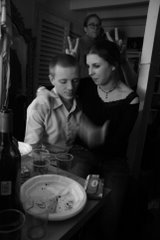

First things first: are you criticising the 35 hour week or shops not opening on Sundays? and how do either make us lazy? Concerning the former, you might be surprised to learn that the 35 hour week is not the norm, any cadre (equivalent of a managerial position) or for that matter artisan boulanger could tell you that. Equally, for those it does concern what exactly do you have against having an extra afternoon/morning off a week, or a couple of extra days off a month? There are some things money can't buy, and spending time with your kids on a wednesday afternoon or taking a long weekend to visit the family are obvious examples. It might even be because of a certain equilibrium between work and leisure that French workers have the highest hourly productivity rate in Europe, something you forgot to mention when qualifying us of lazy. It's not all about length I guess, quality does count.
As for the catholics being behind the plot against Sunday shopping I find that very strange, the main argument against it being, as far as I can tell, that it is the most vulnerable workers (women working part time, pour ne pas les nommer) who would be working that day (for no extra pay I might add), when they would normally spend it with the family.
Again, it all boils down to the question of whether a strong(er) economy, fueled by more consumption and more working hours, is really what makes a society happy and healthy. We have good, free, schools, an excellent health service, and awesome transport. Who cares if the train driver works 35 hours a week when you can go from Paris to Marseille in under 4 hours?
France has its problems, no doubt. As you say, high unemployment, sluggish economy , massive debt, (hang on a sec, aren't you also British?) crappy universities, abominable prisons, social and racial inequality, etc. But there is also much to be proud of, not least the fact that we cling to the belief that we are not just labour, but human beings.
Last but not least: waiters will never refuse you for lunch to take a two and half hour lunch break. they geneally eat at about 11.30, before the first rush, or at 3 after the second. In fact the 2 and a half hour lunch beak is a myth today, and when it does last more than an hour, it's not so bad because we usually leave the office around 8, rather than head off to the pub at 5...